

New World Trade Order: Trump Tariff Announcement of April 2, 2025
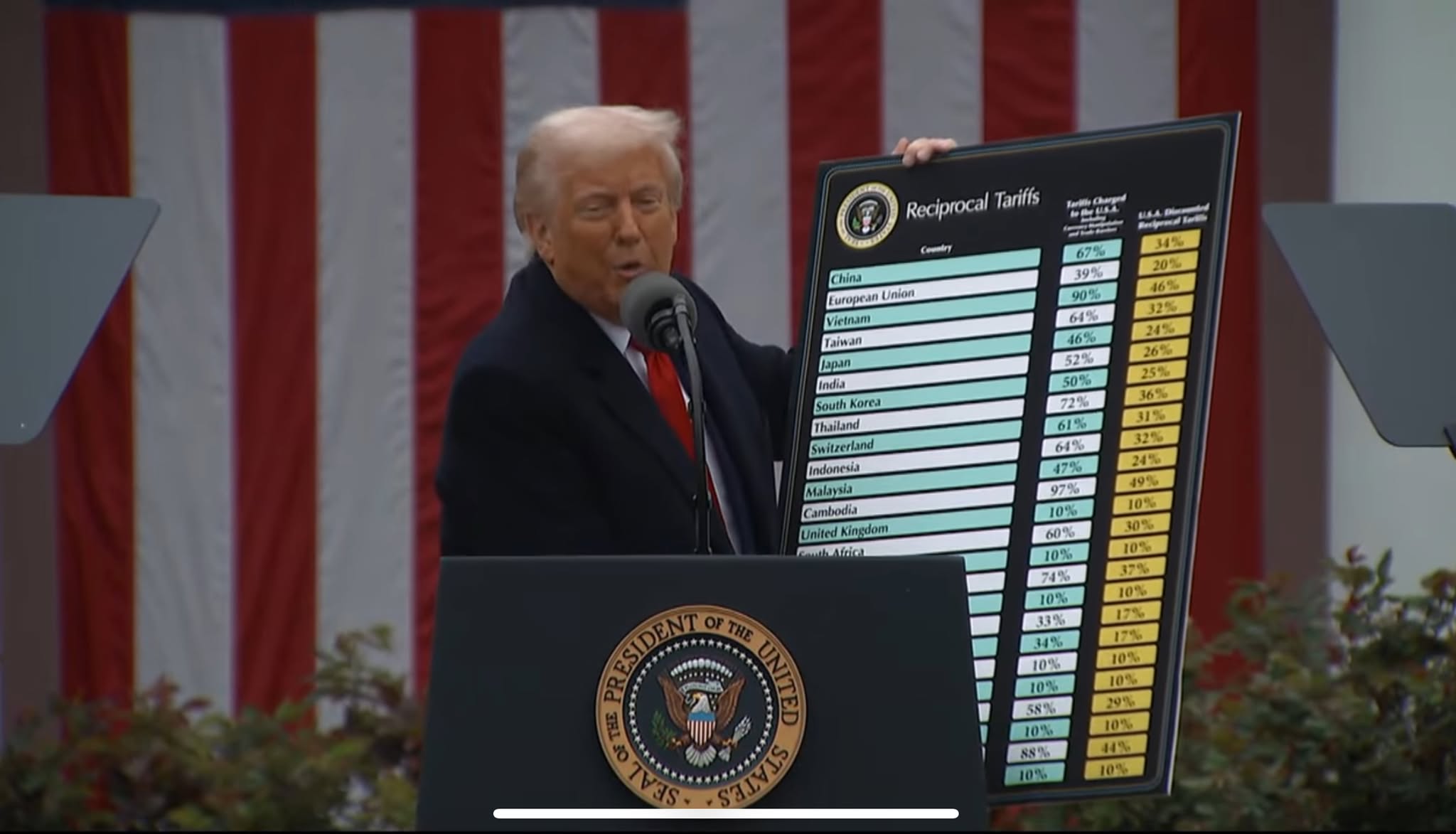
United States president Donald Trump announced his promised tariffs on imports on April 2, branded as “reciprocal tariffs” that classifies nations based on tariffs to supposedly balance trade balance with the United States. President Trump announced his new tariffs in a live address to the American nation by calling “April 2nd, 2025 as Liberation Day, when its industry was reborn and its destiny reclaimed.” President Trump’s executive order imposes reciprocal tariffs on countries around the world, which president Trump explained in his simple terms as “they do it to us, we do it to them.” President Trump also called this executive order as a declaration of economic independence.
This new shift in America’s foreign economic policy targets to bring jobs and factories back to the States in a bid to create more competition and as result reduce prices for consumers.
In his speech President Trump referred to Japan as an example saying that 94% of the cars in Japan are made in Japan. “Toyota sells one million foreign-made automobiles into the United States” whereas General Motors, for example, doesn’t have sales in Japan. In this ambitious trade policy shift, the United States aims to boost local automobile production by imposing 25% tariffs on all foreign-made automobiles.
Regarding North America, President trump said that the US had been subsidizing Canada and Mexico, however Canada had higher tariffs on dairy, for example, and announced tariffs on imports from its closest trade allies and neighbors. For Canada and Mexico, non-USMCA compliant goods will see a 25% tariff (including automobiles). USMCA compliant goods would continue to receive preferential treatment.
When speaking of Europe, Donald Trump said that the European Union bans US poultry imports through non-tariff barriers but wants to sell their cars into the US market.

International reaction to the reciprocal tariffs varies as some countries prepare to announce counter-tariffs, and others try to compromise and negotiate a deal.
European Commission President Ursula von der Leyen said she deeply regrets this choice as it will have immense consequences, the global economy will suffer as uncertainty will rise. Donald Trump has placed a 20% reciprocal tariff on the EU. The President of the European Commission says EU will retaliate, and has already finalized its first package of retaliatory measures. She also said that the tariffs “will affect consumer goods prices worldwide, it will be felt immediately, grocery and medication prices will cost more, transportation as well, and inflation will go up.”
The United Kingdom’s tariff rate was 10% due to Brexit. In response, Prime Minister of the United Kingdom said that nobody wins in a trade war, and that the country is working on negotiations of a trade deal between the two countries.
Asia was largely affected by US tariffs too. China vows retaliation on 54% tariffs. This comes in an additional 34%, and it is going to hit China the hardest, resulting in a serious escalation of China-US trade war. China claims that the US’s action violates the rules of WTO and that Beijing will take counter-measures.
Vietnam is among the countries with highest tariffs with 46%. For Vietnam this move is expected to have a very strong impact as the US is its largest export market, whereas 30% of its GDP consists of incomes generated from exports to the United States. In contrast with China, Vietnam is not preparing retaliation but is undertaking measures to negotiate better tariffs. Vietnam’s Prime Minister Pham Minh Chinh has convened a “quick response team” with a mandate to formulate strategies to mitigate tariffs’ effects, including reducing its import duties on US products and seeking diplomatic ways of negotiation to seal a better tariff deal with the US.
Trump announced repatriation of companies from Asia, such as a large investment by Apple ($ 500bln), Opan AI and Oracle ($ 500 bln), Nvidia, TSMC that is the biggest chip producer company from Taiwan and others.
This is a major economic world news that is set to change the world economic order, transform trade routes, create tectonic changes in world politics, and perhaps also result in a totally different world from what we are living in now.
By KAMO MAILYAN, CITP® | FIBP®
Entrepreneur, International Trade Professional
Toronto-Yerevan