

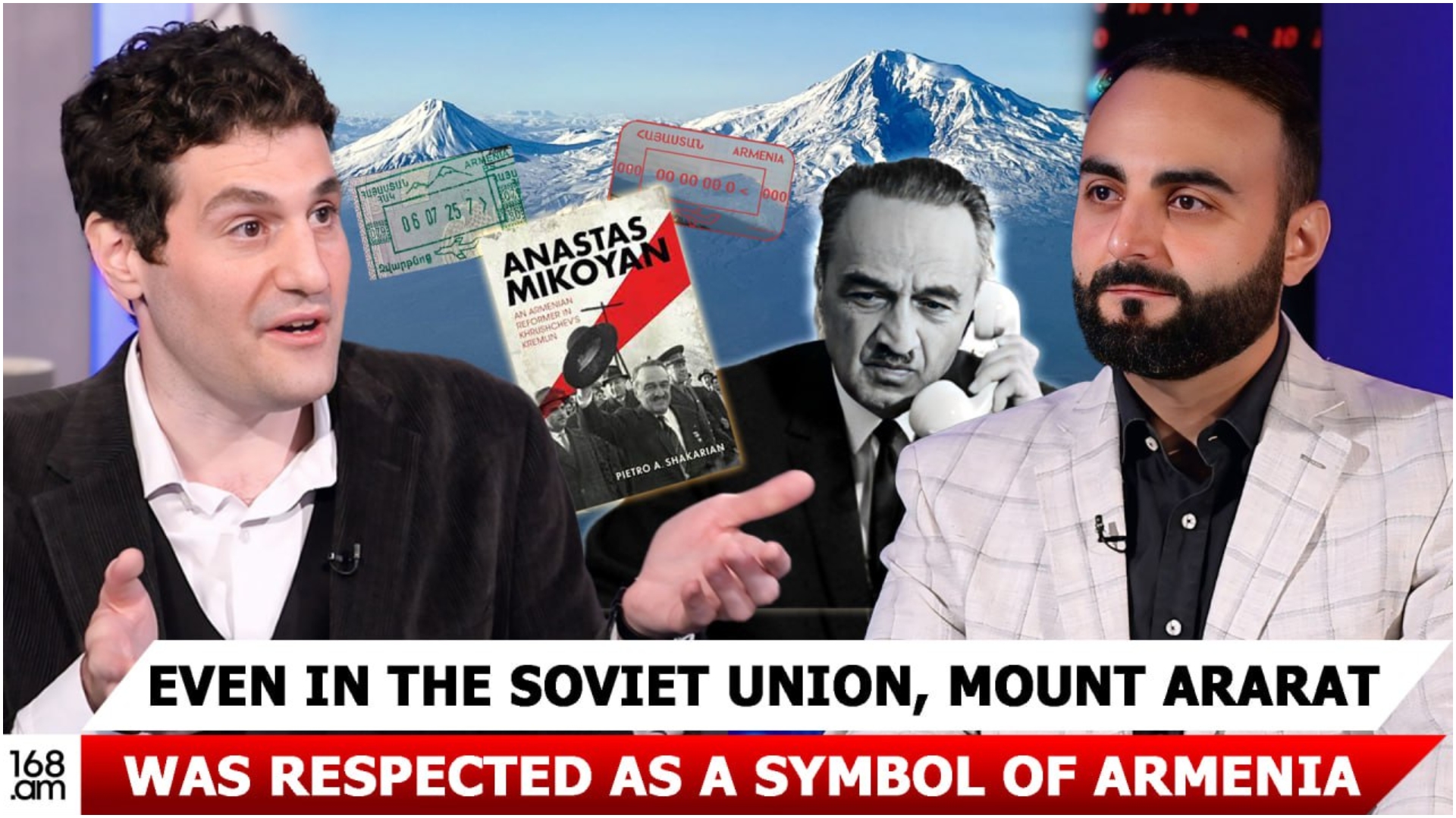
Even in the Soviet Union, Mount Ararat was respected as a symbol of Armenia: Pietro Shakarian
Dr. Pietro Shakarian, lecturer in history at the American University of Armenia, published a new book called “Anastas Mikoyan: An Armenian Reformer in Khrushchev’s Kremlin.” During an interview with 168 Hours, he talked about his book as well as some geopolitical issues.
“I didn’t think that Anastas Mikoyan was so involved with Armenian affairs. I thought he was more just focused on Moscow affairs. But in particular in this period of the Khrushchev era, he was actually really involved with assisting the Armenian leadership in Yerevan with infrastructure projects, he acted as an informal advisor, he acted sometimes as an informal lobbyist for Armenia, so for instance with Lake Sevan. As we know, for hydroelectric purposes, the waters of Lake Sevan were used and it resulted in the lowering of the level of the lake to such an extent that Sevan island became a peninsula. And so it was decided that we have to stop this. So the Armenian government realized we have to redirect the water from the Arpa River to Lake Sevan. But this was a very, very costly project for Soviet Armenia. And so they were seeking the advice of Anastas Mikoyan. And Mikoyan said, well, don’t tell Khrushchev the full cost of the whole project because he will go through the roof. He will be really upset. Because the idea was the Armenians needed money from Moscow, from the all-union budget. So Mikoyan said, just give him the cost of the tunnel itself and not the associated infrastructure. And in addition to that, just say that also in addition, maybe 30 % of the budget of this project will be covered by the Soviet Armenian Republic. So he was involved with such projects as this in Armenia and also many more too mean also helping with the developed resort towns, village economies in Sanahin, also in projects in Kapan and various parts of Armenia. He was involved and he actually visited Armenia many times, most notably in 1962. There was even a film about his visit to Armenia in 1962. So it’s extraordinary history that I never even knew about before,” he mentioned.
In March 1954 Mikoyan gave a significant speech in Yerevan, and according to Shakarian, it is imprtnant to notice the historical context. “Stalin died a year earlier in March, 1953, and Mikoyan came to Yerevan on March 11th, 1954 and gave this very significant speech where he called for the rehabilitation of the poet Yeghishe Charents and for the republication of the Armenian writers, such as Rafael Patkanian and also where he also called for the restoration of the memory of Alexander Myasnikyan that we should preserve his memory,”he mentined and added that it was the de-Stalinization process in Armenia.
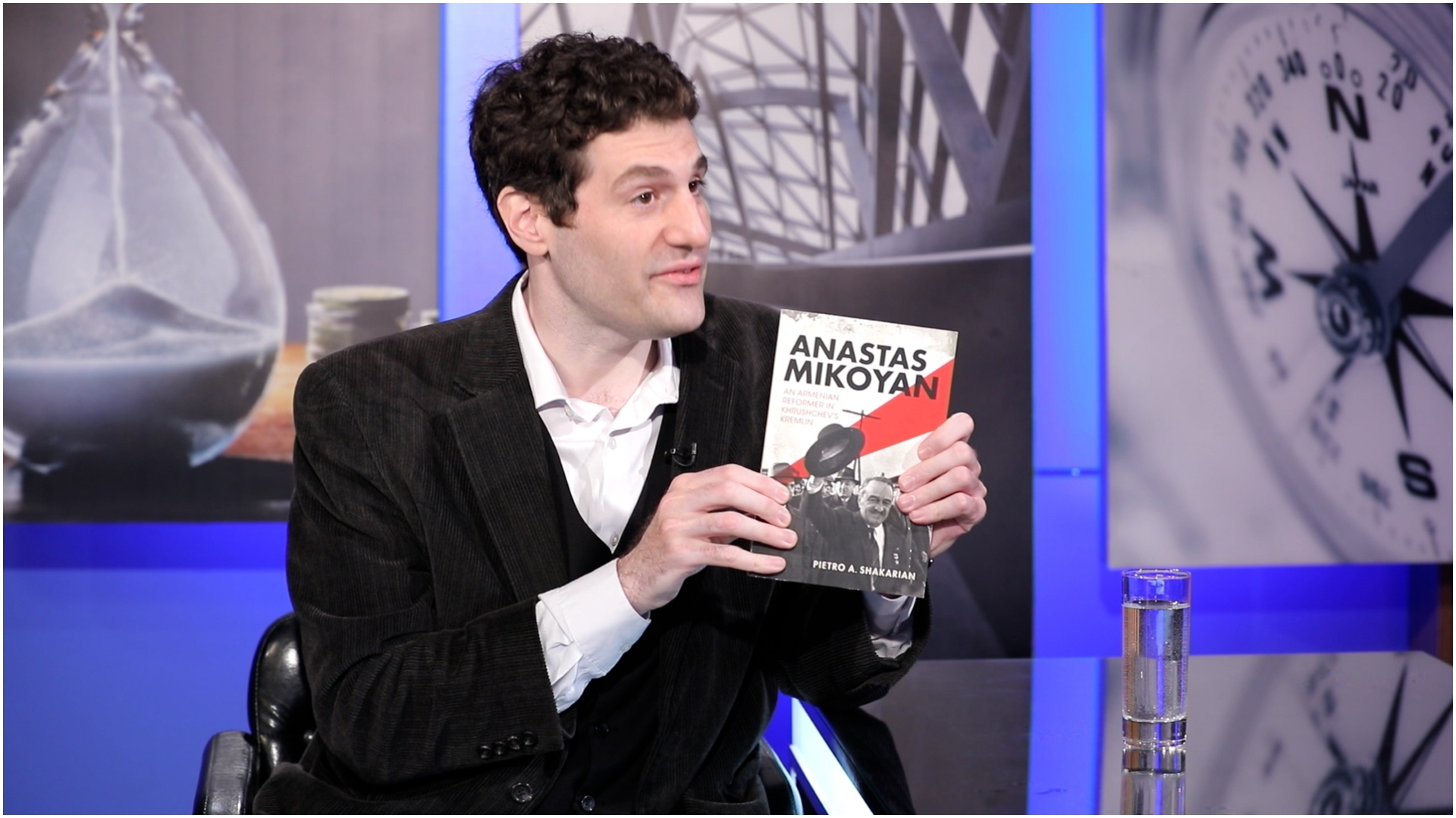
“Mikoyan’s speech, it opened the door to the Yerevan demonstrations of 1965 about the Armenian genocide and then ultimately the Karabakh movement of 1988. This speech on many levels was very important… Mikoyan went to Yerevan on Stalin’s orders. That this was a kind of a forced intervention where Mikoyan was forced to participate in these repressions in Armenia. Also, first and foremost, mean, some context is important to highlight, because Armenia, the repressions were already very much in full swing. The repressions in Armenia really began in July 1936 when Lavrenty Beria shoots Agassi Khanjian. And basically the problem there for Beria was that Khanjian and his whole network in Armenia represented a threat to his ambitions in terms of dominating politically the Caucasus. And so all these famous writers like Charyants and Bakunts and Totevents and all of them, they were all allies of Khanjian and they were all part of this network that opposed Beria. And the most vocal member of this network was Nersik Stepanian, this national, you communist intellectual in national Soviet intellectual in the Armenian leadership, in the Armenian political elite at that time. So when Beria, got Khanjian out of the way, he then installed his own cronies in Armenia to unleash a real repression against anybody who was loyal to Khanjian and his kind of ideas,”he said and added that Mikoyan was like a last-minute addition and his role in this Repressions even though he was involved with this repressions is documented.
“It needs to be highlighted Nevertheless, it was forced. He was sent there on the anniversary of the execution of the 26 Baku commissars. So Stalin is like sending him a message that if you don’t do what I say, then you might end up like the other commissars, that kind of thing, like the Baku 26.
“What was his opinion about Nagorno-Karabakh/Artsakh issue?” we asked.
“He originally was much more of an internationalist in the framework of the Baku commune. And so he was more indifferent to some of these Armenian national issues early on. He has a letter to Lenin from 1919 where he espouses this idea that he thinks that the Karabakh Armenians wanted to be part of the soviet Azerbaijan at this fifth congress of Karabakh Armenians, but of course we look at the resolution of the fifth congress of Karabakh Armenians, and they actually say emphatically we don’t want to be part of any Azerbaijan in any form. So, somebody in Baku was telling Mikoyan this and Mikoyan got, we can say, bad information…” he answered.
Historian talked about the story connected Mount Ararat and Turkey’s objections to its use on the Soviet Armenian state emblem: “Khrushchev’s memoirs he recounts this very famous story where actually it really dates back to the 20s and there’s some questions, some scholars might say, this legendary, is it not? But it really begins actually with Chicherin, actually, when we go back to the kind of the early Soviet foreign ministry, where basically Turkey complained that the Soviet Armenian coat of arms is Mount Ararat and that this shouldn’t be because Mount Ararat is part of Turkish territory, so you should remove Mount Ararat from the Soviet Armenian coat of arms. And to this, Chicherin or the Soviet Foreign Ministry, and this is what’s recounted by Khrushchev in his memoirs, they responded that, well, okay, fine, but you have the crescent moon on your flag, so does that mean that Turkey claims the moon? And after that, Turkey dropped its objections to Mount Ararat on the Soviet Armenian coat of arms, and that was the end of that. By the way, the Soviet Armenian coat of arms still is very prominent today. So if you were to go take a walk on Republic Square and you look at the government building, what do you see there? Still you see the Soviet Armenian coat of arms. It’s a relief on that building. Mount Ararat is a deeply Armenian national symbol and you can’t make it disappear. Some people might want that to be the case. The current government, unfortunately. It shows you though that even in the Soviet Union, Mount Ararat was respected as a symbol of Armenia and Armenian national culture.”
He called the actions of the current government of Armenia crazy. “It doesn’t change anything because at the end of the day Mount Ararat will always be the Armenian national symbol even though it’s located in Turkey. It is deeply embedded with Armenian history, with Armenian culture, with Armenian traditions.
Nikol Pashinyan said that they are not going to continue the Karabakh movement. According Pietro Shakarian, Karabakh movement at its core, was a national democratic movement: “It was about, first and foremost, the democratic rights of the Armenians of Artsakh/Nagorno-Karabakh to determine their own future. Whether they want to be an independent state, whether they want to be part of Armenia, maybe even if they want to be part of the Russian SFSA, they have the right to determine what they want to do. That was the whole idea of the Nagorno-Karabakh, or that was the whole idea of the Karabakh movement from the start. The core was about their self-determination, their rights. When you have an Armenian prime minister saying that, their rights don’t matter, that I’m going to recognize Nagorno-Karabakh as Azerbaijan and all this, to me, it’s a betrayal of those ideals. It’s a betrayal of those principles of democracy. Because it’s ultimately democracy. What is democracy? It’s not about the diktat, certainly, of Mr. Aliyev in Baku. It’s about the right of the people to determine their own futures. So if the people in Stepanakert want to determine their own future and want to make, you have to think, on February 20th, 1988, when the Nagorno-Karabakh autonomous oblast voted to join Soviet Armenia, that was incredible act of defiance. Because even when Soviet Azerbaijan agreed to give Nagorno-Karabakh political autonomy, going back in the 20s, this autonomy was the lowest form of autonomy they could have, which was the oblast autonomy. And so, institutionally they were very limited in what they could do and they didn’t have a law that said they could join Soviet Armenia explicitly. But yet they made this incredible act of democratic defiance of people power to say look we’re not going to take this anymore, we want to determine our own future whether you and Baku like it or not. If that isn’t democracy, I don’t know what is. And the fact that you have a leadership today in Armenia that claims to represent democracy, but that is not adhering to those values, and that says we’re not going to have, we’re not going to adhere to the principles, the ideals of the Karabakh movement anymore. The ideals of the Karabakh movement of 1988, which is so important. It’s the most important movement to the whole history of the third Republic of Armenia.”
He noticed that Armenia is being constantly threatened all the time by Azerbaijan, which again is making new demands on Armenia, even if Armenia meets all the demands that Azerbaijan wants today: “Aliyev will make new demands tomorrow, and it will keep on going and going and going. We’ll see how things change and how things evolve. It’s very concerning right now.”
By Razmik Martirosyan