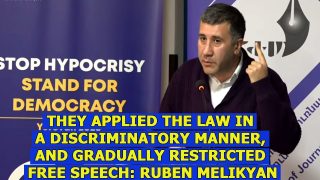


The purpose of the people of Artsakh and the leadership is to return to their papal land, guaranteed by reliable international mechanisms with their fundamental rights. Oskanian
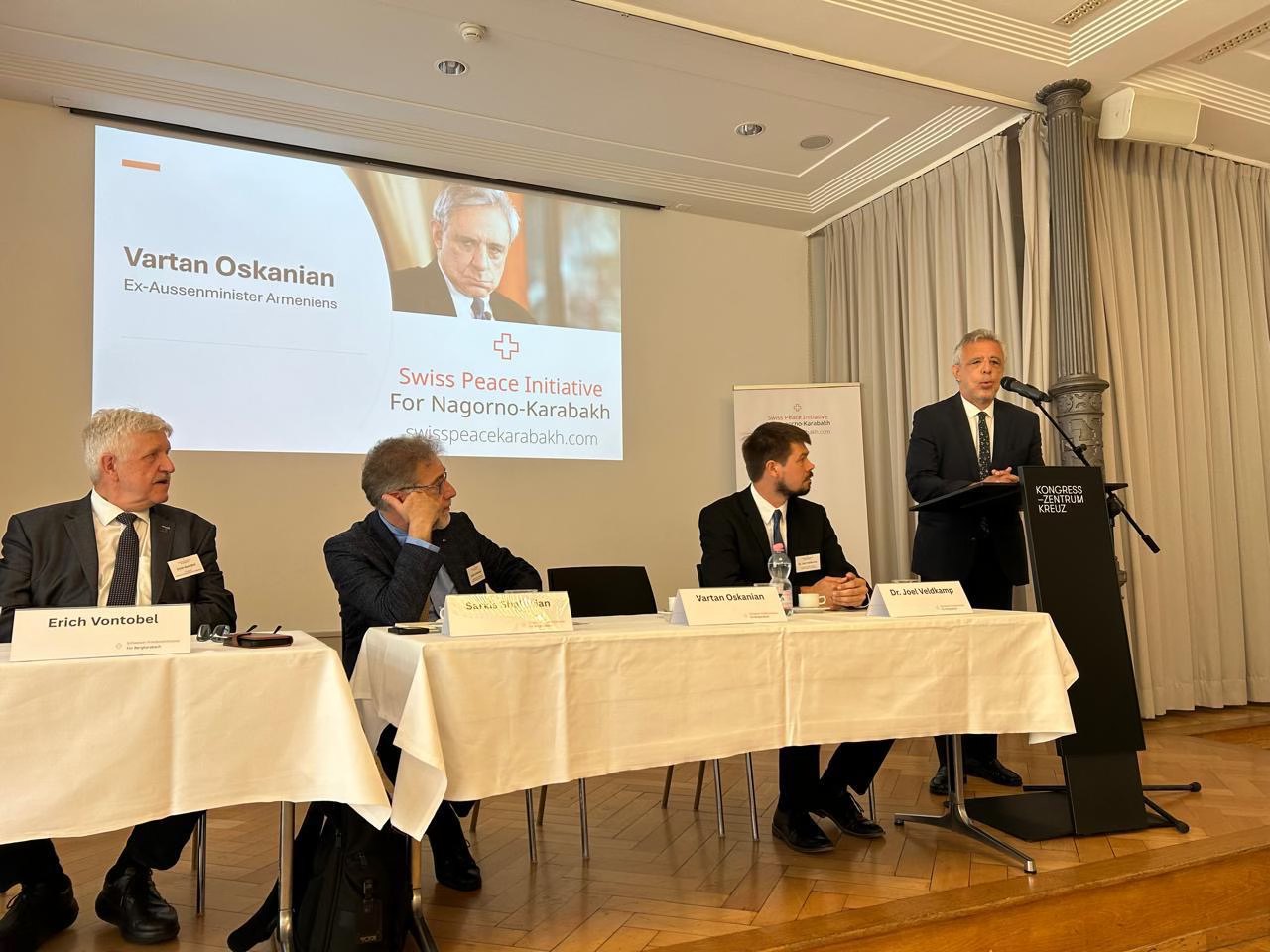
Today, on May 26, 2025, the inter-party committee of 19 deputies of the Swiss Peace Initiative launched the Swiss Committee to implement the decision of the Swiss Parliament, which has a lawful legal significance for the country’s executive power.
The purpose of the initiative is to support Switzerland’s commitment to “enable the open dialogue between representatives of the Armenian population of Azerbaijan and the Armenian population or the presence of international significant actors on the safe and joint return of the Armenian population.”
The commission with a wide range of inter-party support is headed by the Swiss National Council Deputies Erich Fontobel and Stefan Mueller-Altermut.
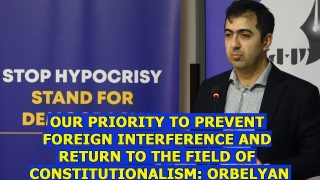
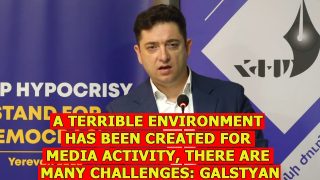
Vardan Tadevosyan, Director of the Committee on the Former Foreign Minister of the Republic of Armenia, the Secretary General of the Swiss-Armenia Interparliamentary Friendship Group, and Director of the International Christian Solidarity Organization, and Director of the International Christian Solidarity Organization, and Director of the International Christian Solidarity Organization, and Director of the International Christian Solidarity Organization. Weldkamp.
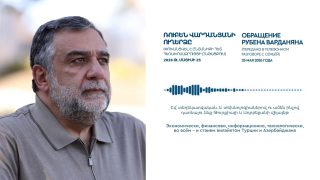
In his speech, Vartan Oskanian said.
“Let me start with a few words of gratitude. I would like to thank the Federal Assembly of the Swiss Confederation to adopt a resolution on the National Council and the Canton Council. Special thanks to the initiators and those who guided the process, bringing it successfully. They are here today, with us, and you have already heard their performances.
I thank the 19 deputies who joined the commission and are ready to implement the adopted initiative. I also express my deep gratitude to those who were outside the parliament, our Armenian and non-Armenian friends in Switzerland, who worked to make this possible with their elected representatives possible.
And finally, which is no less important, I am grateful to the international Christian solidarity organization to organize a fixed support to the Artsakh issue and to organize this important meeting.
Before the main topic, the Swiss peaceful initiative and the right to return, I must make a clear and significant statement. It is important.
150,000 Artsakh Armenians who have been violently displaced from their Millennial Homeland, the threat of war, ethnic cleansing and the threat of genocide, which have historically never been part of the Azerbaijani state, when Armenia and Azerbaijan were independent states after the collapse of the Soviet Union. At that time, the people of Nagorno Karabakh held a legal referendum within the framework of the USSR Constitution and decided to leave Soviet Azerbaijan.
The only period when Artsakh was under Azerbaijan’s control was the USSR years, and even then it had autonomous status. Ironically, today’s Constitution of Azerbaijan is declaring the Soviet government illegal, while sanctifying the Soviet borders. At the heart of today’s conflict is that contradiction.
I’m not saying this to give it to the past, but to clarify our demands are neither imaginary nor unfounded. They are rooted in history, right and justice.
At the same time, I would like to emphasize the people of Artsakh and the leadership are very pragmatic. They realize the dynamics of relations between Yerevan and Baku. Their goal is not to oppose geopolitical realities. Their goal is to return to their papal land with their fundamental rights guaranteed by reliable international mechanisms.
This is not a political demand. This is a human requirement based on international law, surviving trauma and moral clarity.
Moreover, their return on international defense can be a basis for fair and long peace among Armenia and Azerbaijan, especially in such deep-rooted distrust. It is impossible to achieve peace in this region until these people have been rooted out of their land.
On November 17, 2023, the International Court of Justice forced Nagorno-Karabakh to ensure the “safe, unknow and fast return” of people who left Nagorno-Karabakh after September 19 and to exclude the tools of force or intimidation of those people who could force them to escape. The decision was followed by two resolutions in the European Parliament in March 2024, who were openly called on Azerbaijan to be involved in dialogue and guarantee their right to secure and dignified return. Recently, the Swiss parliament decided to hold a platform to the Federal Council for negotiations on the right to return between representatives of Artsakh and Azerbaijan.
It is obvious that this issue is formed in this issue.
Azerbaijan has largely stated that Armenians can return. So the real questions are, as in what conditions.
International law is unequivocal. People cannot be returned to danger, fear or discrimination. And that danger is not theoretical, real and noticeable. Azerbaijan continues to detention former political and military leadership of Artsakh, as well as to Armenian prisoners of war. These prisoners are not criminals. They protected their right to self-determination, which is given to them with a international life. These are the people with whom the sequential foreign ministers of Azerbaijan have to talk about the future status of Nagorno Karabakh. These are the same people with whom the authorized OSCE mediators met to find a peaceful solution to the conflict. They are now political captives. As long as they are imprisoned, real reconciliation is impossible.
We also witness the coordinated destruction of Armenian cultural and historical memory, khachkars are eliminated, the graves are being destroyed, and monasteries are deprived of the Armenian identity.
From now on, our task is to ensure that any return to full international law, including the right to human rights, and the right to ban discrimination, not just the principle of territorial integrity. It is this goal that the proposed forum is to create a neutral and reliable platform for dialogue, where Switzerland will only provide its good services, a table where the relevant parties will discuss the specific conditions. This will be Switzerland’s peaceful initiative for Artsakh.
Switzerland, having long reputation, in the field of neutrality, restraint and compassion, is a unique position to host such a platform.
We know that the Swiss Federal Department of Foreign Affairs has some reservations to start this process. We listened intently to the two Foreign Minister’s speeches in the National Council and the Canton Council before the voting. We fully understand the careful and balanced approach to Switzerland. We know that you have not recognized the former authorities of Artsakh. We respect your desire to avoid unwanted diplomatic consequences.
But this forum is not about catching a party. It is not about to legitimize the one side. It is about opening an area, a neutral, principled area where the muted voices can be heard, where both Azerbaijan and Artsakh Armenians can sit and find a way together. Return road. “