

Confiscation Without Accountability: Anti-Corruption Policy or Redistribution of Property?
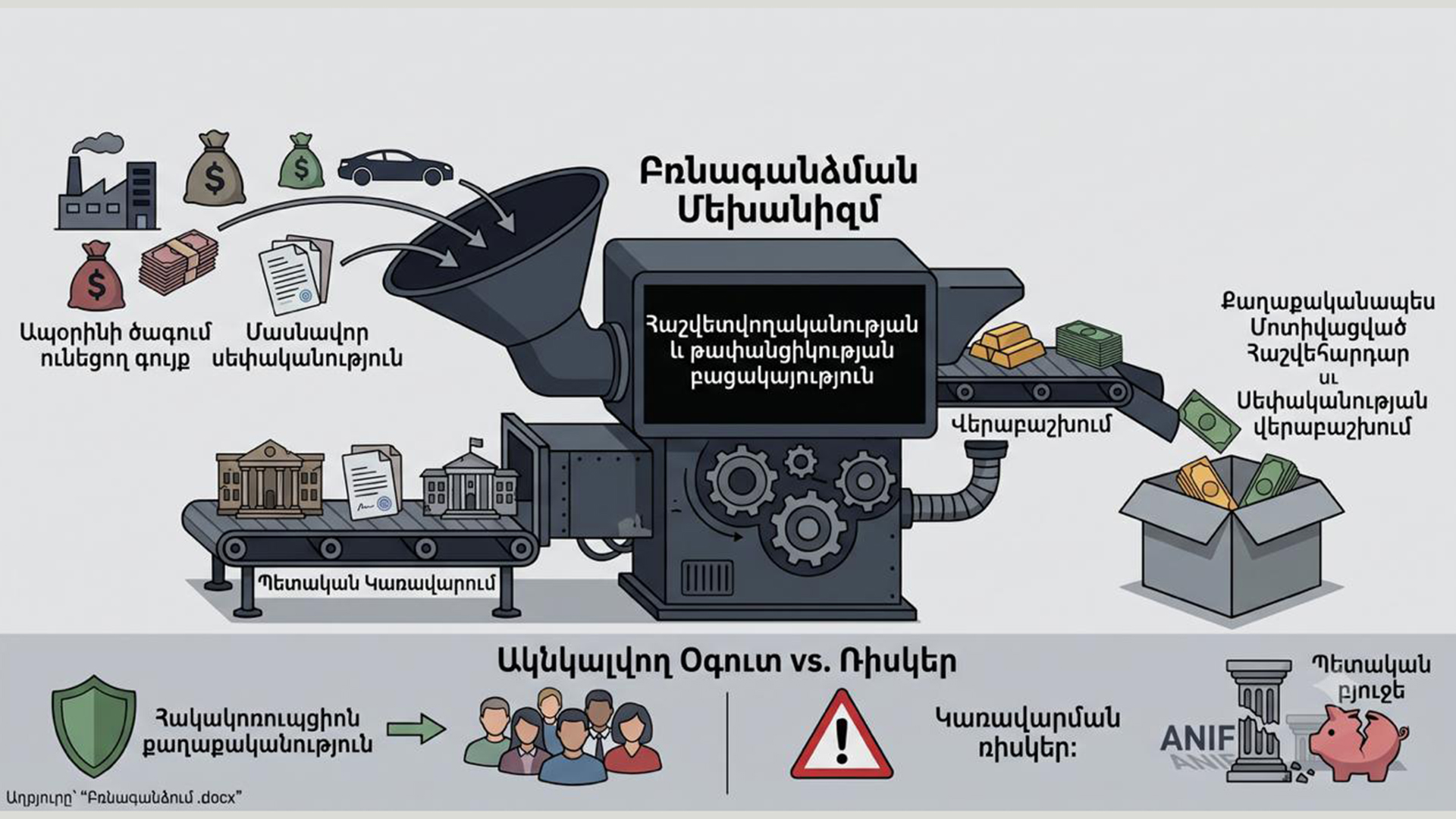
Immediately after the elections, the process of politically motivated confiscation of private property gathered new momentum in the country. The government justifies its actions by invoking the need to return illicitly acquired assets to the public and protect the public interest.
Yet it is telling that, once again, this policy is being applied exclusively to influential political opponents. Such selectivity raises a fundamental question: is this genuinely an anti-corruption policy, or politically motivated retribution pursued through the redistribution of property? What is taking place gives rise to a well-founded public perception of selective justice.
As a result of these measures, the government is assuming the functions of an economic operator, establishing control over enterprises in various sectors of the economy that are connected to substantial financial flows. Yet transferring an asset into state ownership does not, in itself, guarantee effective management or eliminate corruption risks. It merely changes the environment in which those risks arise and reproduce themselves.
A situation has emerged in which the government simultaneously acts as owner, regulator, and the body making management decisions concerning enterprises placed under its control. In the absence of professional managers, independent boards of directors, and transparent, merit-based procedures for appointing executives, an obvious conflict of interest arises. The consequences of ineffective management can be offset through public funds or higher tariffs, while commercially unjustified decisions—or decisions driven by political motives—can be defended through empty rhetoric about “strategic” and “social” objectives.
This practice runs counter to the OECD Guidelines on Corporate Governance of State-Owned Enterprises 2024. The Guidelines require a clear separation between the state’s ownership function and its market-regulation and policymaking functions; operational autonomy for state-owned enterprises; and boards selected through professional, merit-based, and transparent procedures. The OECD stresses that combining the roles of regulator, owner, and market participant creates conflicts of interest and undermines a level playing field.
Armenia’s experience in the state management of commercial assets offers little cause for optimism. The clearest warning is the fate of the notorious ANIF, regarding which every public question and discussion has remained a voice crying in the wilderness.
For years, this state fund operated without a clear mandate, accountability mechanisms, or performance indicators. In 2024, after enormous sums of public money had disappeared, the Government of Armenia decided to terminate ANIF’s operations and liquidate it. The government not only failed to report on the collapse of its own “strategic initiative”; it also placed the entire financial burden of the failure on the state budget—that is, on taxpayers.
The public was never given a comprehensive account of which management decisions had led to the failure, who bore personal responsibility for them, or what institutional changes were needed in the state asset-management system to prevent similar problems from recurring. The absence of answers to these and other important questions supports the conclusion that ANIF’s liquidation was intended to bury the matter and erase its traces, without drawing the necessary legal and political conclusions.
The lack of accountability and transparency is among the central problems in managing assets confiscated and transferred to the state. First, Armenia has no unified public register of assets transferred to state ownership. Nor is it clear why managers are appointed on the basis of political affiliation rather than professional competence and merit, what objectives they are expected to pursue, or how their performance is assessed.
Equally troubling is the lack of comparable data on an asset’s value at the time of transfer and after a period under state management; on revenue generated and public expenditure incurred; or on liabilities, procurement, major counterparties, and transactions with related parties. It is not even clear whether a given entity remains operational or what decisions are being made in the name of the state—or, more precisely, the taxpayer. Under such conditions, claims about “restoring justice” or the “strategic importance” of assets become slogans that conceal management failures, opaque decisions, and abuse.
Under the OECD Guidelines, state-owned enterprises should be subject to the same high standards of accounting, disclosure, compliance, and audit as public companies. Their financial statements should be audited annually by an independent auditor. State oversight or state audit cannot substitute for an external audit.
To mitigate the risks described above, the legal grounds for confiscation are not enough. For every enterprise transferred to the state, the authorities should publicly disclose its current status and appraised value; information about its managers; the objectives of managing it as public property; its financial performance; the scale of state support; and the intended path for its future disposition—whether it will remain in state ownership, be transferred to a specialized operator, or be privatized through an open tender. Financial statements and performance-audit findings should be published regularly, not only after a scandal or liquidation. Otherwise, the lack of information makes it impossible either to assess whether the decisions taken were justified or to evaluate the effectiveness with which confiscated assets are managed.
The central question, therefore, is not how much property the government has confiscated, but how well it has preserved and increased the value of that property, ensured professional and accountable management, and delivered measurable public benefit. The principal safeguard against turning nationalized enterprises into sources of political rent is clearly defined and publicly disclosed management objectives, professional management, independent audit, transparency, and the inevitability of personal accountability when specified economic-performance targets are not met.
Armen Martirosyan
Member of the Supreme Council and National Assembly of the Republic of Armenia (1990–1999)
Ambassador Extraordinary and Plenipotentiary of the Republic of Armenia