

Grand Conspiracy Against the Armenians

“The European Union is going to support Armenia in countering possible hybrid threats ahead of the parliamentary elections scheduled for 2026, as well as in strengthening cybersecurity,” during a meeting with a group of Armenian journalists in Brussels, the EU Commissioner for Enlargement Policy, Marta Kos, stated.
She highlighted that the EU is ready to allocate 12 million euros to help Armenia effectively combat hybrid attacks before the elections. Kos recalled Moldova’s experience, where, according to her, Russia attempted to interfere in parliamentary elections through the active spread of disinformation and cyberattacks.
Thus, ahead of the National Assembly elections, the EU is expressing its support for the Armenian government. This itself contradicts all political norms and the universal principle of non-interference in the internal affairs of other states—a principle that used to be one of the cornerstones of the European value system.
But currently, the EU, without any formalities, is not only offering direct political support to the Armenian authorities, but is also granting them an indulgence just months before the elections—to fight all their opponents by any means possible, under the appealing label of “combating hybrid warfare.”
The issue is not the 12 million euros at all. That is a laughably symbolic amount. The mention of Moldova in the EU official’s remarks means that Armenia’s authorities are being given the green light to do before the upcoming elections what Moldova’s government recently did—to secure their own reelection at any cost. In short, Moldova’s pro-European government declared all its opponents to be “Russian agents,” a “fifth column,” imprisoning many of them, banning the activities of major parties, and cracking down on non-government media.
Exactly the same things that have been happening in Armenia in recent months, though not yet at an institutional level. Kos’s statement is a signal and a directive to Armenia’s authorities that the time has come to institutionalize the repressions.
“She clarified that this support will make it possible to enhance the capacity of Armenia’s relevant institutions to anticipate and respond to hybrid threats… The EU Commissioner also considers the active involvement of the Armenian government essential for effectively countering hybrid threats, stressing that without it achieving results is simply impossible. She particularly stresses the importance of having appropriate institutions able to deliver an adequate response to hybrid threats,” reads the report on the briefing delivered by the EU Commissioner, as transmitted by Armenia’s state news agency Armenpress.
Thus, in the near future we should expect a new, even more institutionalized wave of repression by the authorities against opposition political forces and media outlets—a wave that may culminate in the suspension of party activities, the closure of media outlets, and the arrest of political opponents.
And the European Union, which has already granted Armenia the status of “a bastion of democracy,” is now giving its prior approval—guaranteeing from the outset that it will not only turn a blind eye to gross violations of human rights and freedom but will even praise the Armenian authorities for their “contribution to combating Russia’s hybrid warfare.”
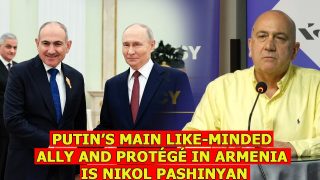
P.S. Moldova and Armenia, despite situational similarities, have one essential difference. The anti-Russian stance of Armenia’s authorities—of Nikol Pashinyan—which earns him Europe’s support, has so far been mostly rhetorical. At the highest political level, he receives nearly the same attitude from Russia, where at most, critical remarks are delivered through experts while he is accepted officially as “one of their own.”
It is highly advantageous for Russia when Pashinyan, labelled a “democrat” by the West, behaves internally like a typical autocrat—thus fitting neatly into the Eurasian sphere, which the same West calls “the club of dictators.”
In reality, what we are dealing with is the “bastard” syndrome long known in foreign policy—a term usually used to describe a government that pleases one geopolitical pole. But in Armenia’s case, it applies almost equally to both opposing poles.
A major conspiracy is being prepared against Armenia and the Armenian people, in which—according to the logic of the genre—the opposing poles will be fighting each other at the level of propaganda. As a result, through the re-election of Armenia’s authorities, each of them will get what it wants—at the expense of Armenia’s statehood and the Armenian people.
Harutyun Avetisyan