

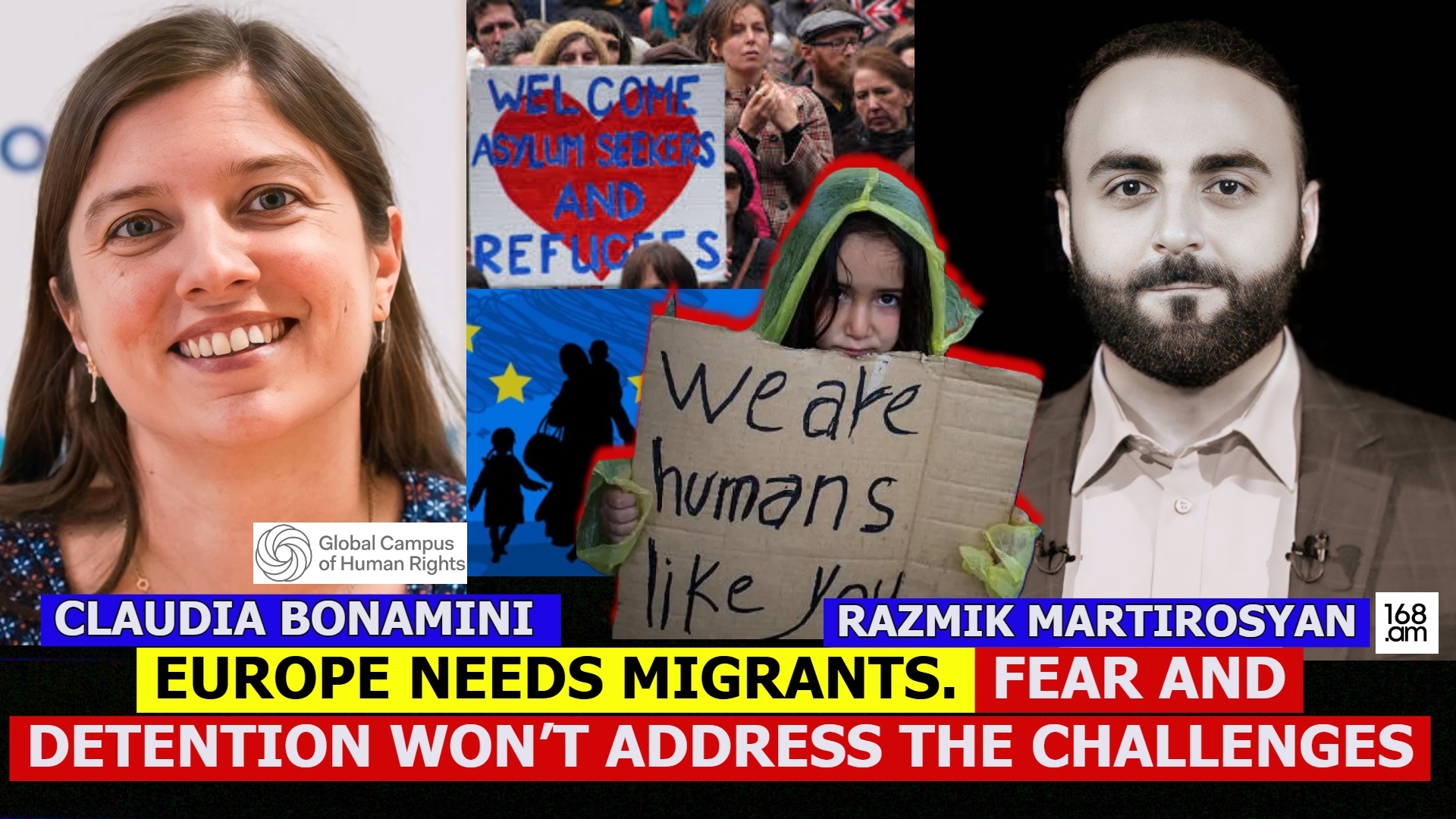
Europe Needs Migrants. Fear and Detention Won’t Address the Challenges: Claudia Bonamini
168 Hours continues its collaboration with the Global Campus of Human Rights. In this episode, we interviewed Claudia Bonamini, an expert on migration issues and an alumna of the Global Campus of Human Rights.
“I think migration is a phenomenon as old as humankind, and it’s true that migration brings challenges. Living together is challenging. When you bring together people with different habits, religions, and languages, it requires an effort. This is a fact.
In today’s world, mobility is greater, and everything moves much faster. There are more conflicts, which means more people are being forced to flee. This combination, more people leaving their homes and higher mobility, makes migration more visible in our societies, and that visibility can make people feel afraid.
Unfortunately, the political response is not to say, ‘Let’s make it work, let’s live together, let’s find solutions’. Instead, it’s the opposite—a closing of doors and, in some ways, a crisis of values. We don’t want to share our welfare because we’re afraid of losing it. That fear is, to some extent, understandable, but the response to it is, in my view, truly saddening,” she said.
Bonamini believes that the last round of legislative changes, which culminated in the so-called European Pact on Asylum and Migration last year, had a strongly negative impact.
“To get back to a positive direction, many changes would be needed. If I had to name priorities, the biggest issue is access to protection, and that means, first of all, access to the territory of the European Union. These days it is almost impossible for people in danger, people fleeing war or persecution, to legally enter the EU. There is no such thing as a visa to request asylum. As a result, everyone, including those fleeing conflict, is forced to travel irregularly. This means you risk being detained and start your whole procedure on a negative footing. Ensuring more legal pathways to reach the EU is problem number one. The second priority is to end the practice of detention and to invest in solid reception systems. Detention is increasingly used upon arrival as a deterrent, to control numbers. It doesn’t work. It becomes a self-fulfilling prophecy: if you threaten people with detention, they will try to abscond. If I were threatened with detention, having done nothing wrong, I would also try to escape. This only deepens the vicious circle,” she noted.
She added that not all people arriving in Europe are refugees fleeing wars. Some are escaping equally severe problems, such as extreme poverty, but these are not currently covered by protection status:
“Some people will ultimately receive a negative decision. But if you work with them from the start in a welcoming way, you may find other solutions, such as voluntary return to their countries—only this time with a different experience, stronger and more resilient, rather than broken for the rest of their lives.”
Bonamini also emphasized that Europe needs migration:
“Europe is an aging continent, so even just for that reason—also for our pensions—we need it. I don’t like to rely too much on this utilitarian argument because, for me, it’s all about human beings and human rights, but it is still an argument.”
She expressed doubt that many European-level policymakers have actually met the migrants they talk about:
“In my 15–20 years of work on migration, I have never met anyone who said, ‘I came here to profit from the social system.’ I have only met people who said, ‘I want to work, I want to build a better life for my children, I want protection.’
But if you traumatize people along the way—forcing them to cross deserts, endure detention, and then wait for years in reception centers or even on the streets—you break people who were perfectly capable of contributing when they started their journey. Many migrants are very young; many are even unaccompanied minors. If you treat these children the way we do, you can’t be surprised if some of them later radicalize or fall under the influence of extremist groups that treat them as heroes. Then we are surprised when they turn against our society.”
When it comes to solutions, Claudia Bonamini believes that: “We should all try to go a little beyond our fears, keep an open mind, seek encounters, and see people as people. We should also make the effort not to believe everything we are told about migration, and maybe try to experience and understand it for ourselves.”
By Razmik Martirosyan