

Migration: what do figures hint?

In its report (2016) on Armenia’s social snapshot and poverty RA National Statistical Service (NSS) introduced some data on 2012-2015 migration.
We have singled out one of them, which is one of the indices, most bothering to us. It refers people, who have left Armenia and didn’t return as of late 2015. In other words—migration. Let’s cover it one after another.
Where do Armenians depart?
Main destination of Armenia’s citizens absent from their permanent settlement in the period of 2012-2015 and not returned as of late 2015 is Russian Federation (RF). This wasn’t a secret, however, the National Statistical Service once again confirms it by submitting concrete data.
Thus, throughout 2012-2015 number 11.9% of h/h members aged 15 and over absent from their permanent location for 3 months and more as of late 2015 have been in the territory of the Republic of Armenia (RA)—in Yerevan, RA regions, 13% in NKR, and 75.1%—in other countries, from which: overwhelming majority have been in RF—71.6%.
The period of h/h members (56.4%) involved in external migration processes with the duration of more than three months (without moves within the Republic) and not yet returned from abroad as of late 2015 comprised 4-12 months, and for 43.6% that period comprises a year and more.
Why do they leave?
There is no any secret in this issue as well: people mainly leave to work abroad. However, other reasons are existent as well. Official statistics allows understanding main reasons impacting on the decision of those departed with the intention not to return.
68.2% of persons involved in 2012-2015 migration process and yet not returned as of late 2015 have left for work. Moreover, more 2.8% leave for seeking a job. 3.5% left Armenia out of family reasons, 2.8%—for education or training.
The report didn’t provide absolute figures, instead it states what’s the distribution like regarding persons aged 15 and over, who have left Armenia in the period of 2012-2015 with no intention to return. For a clear picture we have turned the data into a Chart.
From which regions do people migrate more?
This is, perhaps, the most interesting part, and we have worked a bit on indices provided by the National Statistical Service for a clearer snapshot.
The report didn’t provide absolute figures, instead it states what’s the distribution like regarding persons aged 15 and over, who have left Armenia in the period of 2012-2015 with no intention to return. For a clear picture we have turned the data into a Chart.
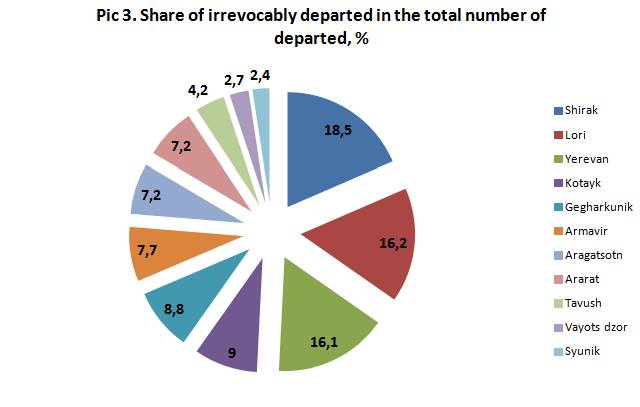
In the mentioned periods 18.5% of irrevocably departed compatriots are from Shirak region, i.e. it’s the leader of migration.
Lori follows it (16.2%), and Yerevan is the third—10.1%. Vayots Dzor and Syunik are ranked the last regarding specific gravity, respectively 2.7% and 2.4% (Chart 3).
However, these figures don’t allow understanding the clear snapshot. In this regard number of population in the regions should be taken into consideration. For instance, if 100 people have migrated from city A with the population of 1000, and 70 people from city B with the population of 500, then city B is more tended to migration (in city A specific gravity of those departing comprises 10%, and in city B—14%).
With this logic inclination to migration for Armenia’s different regions should be calculated.
Firstly, how many persons have departed from each region? As already mentioned, NSS doesn’t provide this data. However, according to RA State Migration Service, the balance of those departing and arriving in Armenia through 2012-2015 is negative: -159100 persons (-42800 in 2012, -31200 in 2013, -41700 in 2014, -43400 in 2015). Citizens of other countries are also included in these figures, however, in any case, they may be taken as ground to understand approximate picture of migration.
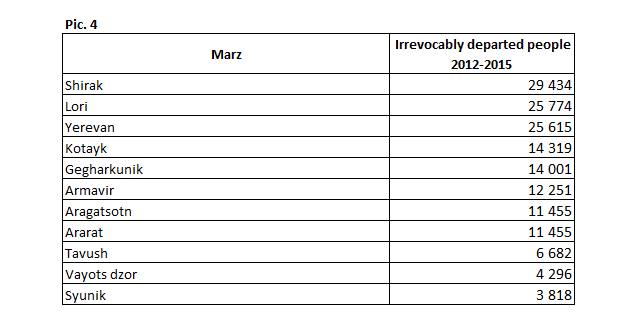
If we distribute this number of migrants (-159100) according to the percents provided by the NSS, we’ll have the snapshot on the number of people irrevocably departed in the period of 2012-2015.
It’s introduced in the Table below (Table 4). As we may see more than 29 thousand persons have left Shirak, 25.8 thousand—from Lori and 25.6 thousand—from Yerevan.
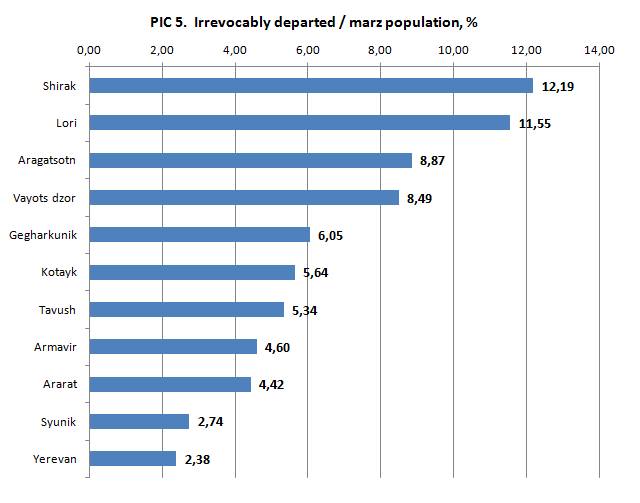
It’s worth passing on to the most curious part: combining these figures to the number of population in each region (data on Armenia’s permanent population for 2015 provided by official statistics are taken as a ground). The results are enshrined in Chart 5.
Two top regions are Shirak and Lori. Number of irrevocably departed from Shirak comprise 12.19%, and from Lori—11.55%. And where is Yerevan, which was ranked the third? It appeared on the last position and comprises 2.38%, which is the lowest among the regions.
Instead, Aragatsotn appeared on the third place, which have left about 9% of the population.
This Chart indirectly shows something else as well. People more migrate from the settlements, where social conditions are harder, unemployment level is high, economic activity is low and etc. Thus, one may also have a general view in which provinces the condition is comparably bearable and the contrary.
It turns out that Shirak, Lori, Aragatsotn and Vayots Dzor are in harder condition (which by the absolute number of those departing were ranked the last).
Instead, people migrate less from Syunik, which, perhaps is conditioned by operating mining companies (by the way, upon official information, highest average salary is recorded in Syunik).
And, of course, Yerevan is in the most favorable condition. Those irrevocably departing comprise 2.4% of the population. Besides, the capital compensates its migration by immigration from the provinces.
It may considered that this is natural, however, on the other hand, the snapshot indirectly edifies centralization of economic activeness and resources in Yerevan.
By Babken Tunyan