

Armenia is sitting on a powder keg … Does Pashinyan use Zelensky’s visit to provoke Russia: John Eibner
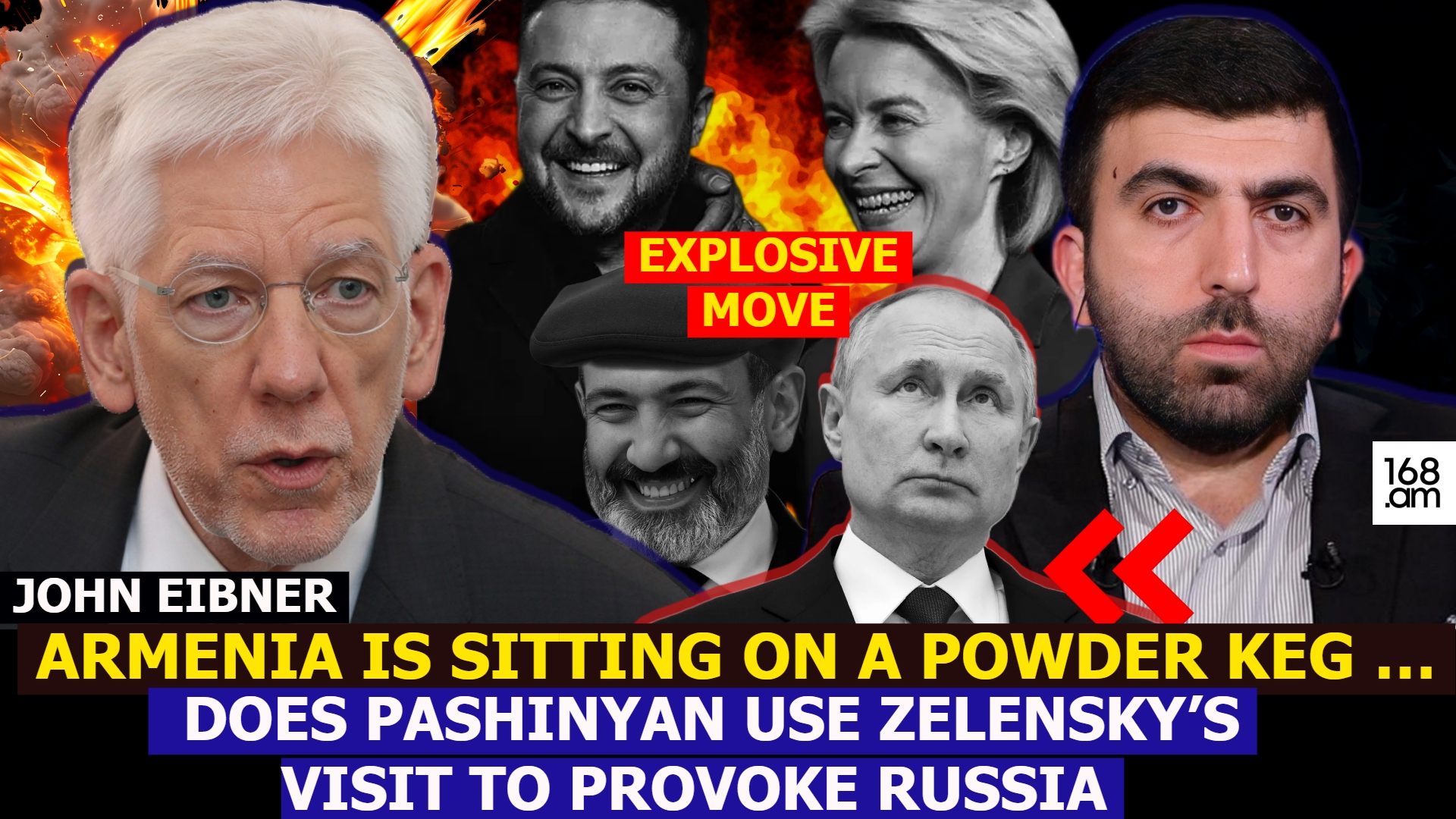
“Welcome, dear followers. This is the “Review” program on 168 TV. I am Aram Sarkisyan, and Dr. John Eibner, President of Christian Solidarity International (CSI) human rights organization, is our guest today. He joined us from Switzerland.”
Aram Sargsyan: Good evening, Mr. Eibner. How are you?
John Eibner: Good evening, I’m great and it’s wonderful to be back with you. Thank you very much for inviting me to join you tonight.
Aram Sargsyan: Thanks, nice to see you. And as far as I know you have quite busy and scheduled days in recent days and you were accompanying the Artsakh/Nagorno-Karabakh Armenian delegation visited Switzerland these days. Would you first of all tell us what was the aim of this visit, what kind of meetings did they have in Switzerland, a country supporting the right of repatriation of 150.000 Armenians of occupied Artsakh to their homeland? What did you discuss with them, what did they discuss with the Swiss parliamentarians and other officials?
John Eibner: Well, you may remember that just over a year ago, the Swiss parliament overwhelmingly passed a motion calling on the Swiss government to convene a forum, to provide a platform for dialogue between Azerbaijan and the leadership of the forcibly displaced Artsakh community under international supervision. It was a very simple motion. The fact that it was passed by Parliament as a motion, meant that this becomes Swiss foreign policy.
The Swiss Government has an obligation now to try to convene such a forum. And so the aim of this visit was to, one, encourage the Swiss Government, through parliamentarians, to be energetic as they fulfill their obligation to try to convene such a forum and to also simply thank the parliamentarians that voted for this motion, and especially a committee of 19 parliamentarians under the leadership of Erich Vontobel and Stefan Müller-Altermatt, who maintain this support group of parliamentarians who continue to press for the Swiss Government to hold this forum, of course, with the view to creating conditions for the Karabakhis to return to their homeland to live in peace and dignity in their own land with their human rights intact.
That was, in short, the purpose of the meeting. So we had a very good meeting yesterday afternoon with a set of parliamentarians and other activists and interested parties in which Ashot Danielyan, who led this small Karabakhi delegation, was able to, one, thank the Swiss parliamentarians and the others who support this, bring them up to date on what the current situation is with the forcibly displaced people of Karabakh, and to assure the Swiss parliamentarians that the Karabakh issue is not closed from the point of view of those who were affected by it. We all know that various statesmen, including the prime minister of Armenia and the president of Azerbaijan all say that the Karabakh issue is closed.
They want it to be closed. They have their own political reasons for wishing it to be closed, but it is not closed. And so this message was very strongly conveyed by Ashot Danielyan, Speaker of the National Assembly of Artsakh, directly to the Swiss parliamentarians and public. The Artsakh issue is not closed.
Aram Sargsyan: And what about the Swiss parliamentarians? I mean, are they on the same position that the Karabakh issue is not closed?
John Eibner: Of course they are, because if they believed that it was closed, they never would have voted in favor of this motion. They never would have compelled the Swiss Government to try to achieve this platform of dialogue. If it was closed, that would have been the end of the matter. But they know that it isn’t closed. They know that it is not closed for the victims of the forcible deportations, the ethnic religious cleansing. It’s not closed for them and it really isn’t closed for the world because fundamental human rights can never be closed. They’re human rights.
They’re eternal, they’re universal. They cannot be closed because authoritarian leaders for their own interest say that these human rights issues are closed. They’re not closed. And so the Swiss parliamentarians respect that and they want to encourage the Swiss Government and of course other governments to lend their support simply to provide a forum for discussions, for dialogue between Azerbaijan and the leadership of the community that has been forcibly displaced. The Armenian government has actually no role in it. The Armenian government is not mentioned in this motion. It calls for a dialogue between the government of Azerbaijan and the leadership of the forcibly displaced Karabakh community. That is what the motion calls for, and it does not predetermine an outcome. It does not say that this must be the outcome that must be the outcome.
Of course, we would all wish for there to be an outcome in which the human rights of the displaced Karabakhis are respected. But at this stage, we simply want to create a forum for dialogue, a peace forum, for dialogue, and so far, the government of Azerbaijan seems to say “no”, that they’re not interested. They say that it’s closed. The Government of Armenia does not seem to want to support the Swiss peace initiative. They too say that it is closed for their own reasons.
Aram Sargsyan: But are there some discussions or any attempts with Baku to start this forum? Could we have the brief conclusion that Switzerland, quite unique and important player in international relations and in Europe, says that the Karabakh issue is not closed?
John Eibner: Switzerland has said that by virtue of this motion. Now, what happens with the Swiss Government, how energetically they press for such a forum to take place, what channels they use to bring it out, some of it is not made public, but they have an obligation to try to create this. And we understand too that much of the international community wants this issue closed. This becomes a problem for the Swiss Government because the Swiss Government has a difficult time acting as a solo actor. There should be broader international support for Switzerland as Switzerland strives to create such a forum. But the international community, of course, the Western powers and Turkey and Azerbaijan, including when I say the Western powers, including the heads of state who will be with you next week in Yerevan at the meeting of the EU summit and the meeting of the heads of state of the European Political Community. Most of them would prefer this issue to be closed. Life is simpler for them if it is closed.
The Armenian and the Karabakh problem creates complications for them, and if they can find a way to close the issue for all time, then they will seize this option. But there are voices that say, no, the issue is not closed and we will not allow them to simply close the issue. It will continue as long as there are Karabakhis, it will continue as long as there is CSI, It will continue to be an open question. As long as there are Swiss and other parliamentarians, the issue will remain open. You may be aware that not long after the ethno-religious cleansing of Karabakh by Azerbaijan, the EU Parliament also passed its own resolution. And this resolution was very damning of Azerbaijan for its violation of human rights.
Aram Sargsyan: But they forgot already, huh?
John Eibner: Well, they haven’t forgotten already. The parliamentarians know it, but the most important, perhaps, thing about the resolution is that they too, like the Swiss parliamentarians, said that there will be no sustainable peace unless there is dialogue with the representatives of Nagorno-Karabakh. This is in the EU’s resolution. Now that is not binding on the EU executive, but it expresses the view of parliament. So we know that throughout Europe, there are many voices in favor of trying to create a dialogue between the perpetrators of an act of genocide actually, and the representatives of the victims to try to settle this issue once and for all on the basis of international human rights law. This is happening now. It’s going to be a long process, as I say, because many states resist this. They find the Armenian question, has plagued European statesmen since the middle of the 19th century. You can read about it, especially in the British Parliament and so on. The Armenian question with the massacres of Armenians in the Ottoman Empire. This question repeatedly appears on the international agenda. It appears, and then there’s a period of quiet. Then it appears again. Of course, it appeared during the time of the genocide.
Aram Sargsyan: You mean the Armenian cause, don’t you?
John Eibner: The Armenian cause. They call it the “Armenian question”. And now it’s come up again. And Europe would find it very convenient for this question to be closed. And many of the European states and leadership figures, elites in Europe, don’t mind if it’s closed through a final solution, through ethno-religious cleansing. For them, it’s a small price to be paid for closing an issue that presents certain geopolitical problems and challenges for them. And this Karabakh issue stands at the middle of the Armenian question today. There are huge ramifications of this Karabakh question, you are surely very well aware of the persecution of the Armenian Apostolic Church by the Armenian state.
Well, this is largely to do with the church’s advocacy for those who were ethically and religiously cleansed from Karabakh, Armenian Christians who were driven out of their homelands, who, now that they have been driven out of their homelands, the traditional methods of Turkey and Azerbaijan of trying to destroy historical and cultural monuments, to destroy traces of the civilization, is now underway. And that is the primary reason why there is this persecution of the Armenian Apostolic Church, because Turkey and Azerbaijan demand it, as a condition for the promise of peace. And the Armenian government with the encouragement of Western powers is willing to meet just about any condition that Azerbaijan and Turkey place on it. This issue of Karabakh is alive and well. If it were to be closed, why would Azerbaijan and Turkey bother destroying churches in Karabakh? It’s not closed for them. They continue to erase the traces of the Armenian culture.
Aram Sargsyan: Including the Mother Temple of Stepanakert.
John Eibner: Of course, including the Holy Mother of God Cathedral. The list can go on, but just recently they’ve destroyed openly one of the main Christian monuments. Sadly, it’s now a monument, not an active church because the people have already been fled, have already fled. But it’s not closed for them. The board, the Muslim board for the Caucasus, which is really an Azerbaijani state apparatus, has tried to just recently given Islamic legitimacy to the destruction of these Armenian Christian churches. So while the issue may be closed for the prime minister of Armenia, and Western leaders may prefer to be closed, it’s actually not closed for Turkey and Azerbaijan. The process continues.
Aram Sargsyan։ Dr. Eibner, you mentioned a lot of key topics and key questions, which are the key topics of our today’s interview, including the persecution of Armenian Church and human rights situation and of course the European Political Community and EU-Armenia summit, but as we were talking about Nagorno-Karabakh issue and the genocide. As you know we had the anniversary of the Armenian genocide 111 years since 1915 and of course it’s again coming actual discussions on this topic where if we try to draw some parallels between Nagorno-Karabakh and Armenia-Azerbaijan and Armenia-Turkey, could we say we will not have a reconciliation between Armenia and Turkey without recognizing and condemning the Armenian genocide by Turkey? And the second one: Nikol Pashinyan in his message on 24th of April he said now we have a state and we have a peace, and peace and state are the guarantees that we will not have Armenian genocide anymore, but if it’s that why did we have the genocide and ethnic cleansing in in Nagorno-Karabakh/Artsakh in 2023, having a state Republic of Armenia?
John Eibner: Yes, well, of course, just having a state doesn’t guarantee human rights and respect for the Armenian population, but it should be the responsibility of the state as a reflection, as an instrument of the nation. And this is where there’s a lot of confusion in Armenia. What the Prime Minister calls “Real Armenia”, that is the state, can make a peace treaty. They can do whatever they want. They can surrender. And really what we’re talking about in terms of a treaty is a capitulation treaty, meeting the conditions of Azerbaijan to surrender. But that is not the same as reconciliation between the Armenian nation and Azerbaijan. The Armenian state is not the Armenian nation.
The Armenian nation is bigger than the state and the state should serve the interest of the Armenian nation. And this is not part of the ideology of the current Prime Minister and the so-called “Real Armenia”. So we can see through the policies that are pursued that there’s an effort to separate the state from the institutions of the nation. On the one hand, there are the institutions of the diaspora, and there’s an effort to disconnect the state from influences in the diaspora that the state doesn’t welcome. There is the effort to force the Catholicos of all Armenians to resign and to make the church the servant of the state.
Aram Sargsyan: And by the way, they have this point or goal in the program of the ruling “Civil Contract” party for the, as you know, the parliamentary elections on 7th of June. The point is to remove the Catholicos of all Armenians. I mean, is it legal? How would you assess this, I mean, in terms of the Constitution and law?
John Eibner: Well, first of all, I’m not a constitutional lawyer, but it certainly is not compatible with religious freedom and the autonomy of religious institutions. You can have this in Azerbaijan, and they do have it in Azerbaijan, where, for example, the head of this Muslim, the Islamic board of the Caucasus is an “apparatchik”. He serves the state, the Azerbaijani state. Now, that does not conform to certainly Western norms of religious freedom, where the religious institutions are autonomous. They should be able to govern themselves. And this becomes crucially important for the whole of Armenian society so that you avoid dictatorships. The church should have a voice, an independent voice, and not be simply a part of the apparatus of the state, a transmission belt for the state. It should be the conscience of the nation.
Aram Sargsyan: And as you mentioned during our one of interviews, you mentioned: “Going to church and worship… But religious freedom is more than that. Religious freedom means being able as a Christian or whatever way you are to express your views, to bring your religious viewpoint to the public, to comment on public affairs, to be able to say, this is not what’s happening in our society, is not compatible with our faith, with our belief.” Well said.
John Eibner: Well, you’ve just said it again. That’s the fact of the matter. Many people, and again, the government will want to convey a false notion of religious freedom and say: Look, people can go to church, they can pray in church, but religious freedom is much more than that. Religious freedom is not simply the right to hold a particular belief or to go to a particular building and pray in a certain way, but it’s to live your life as a Christian, or to live your life as a Muslim, or to live your life without faith. This is what freedom of belief and conscience really is, and it’s very sad to see that this is being degraded in Armenia today, and we have a reversion to state, an attempt for the state to control the religious institutions, much as Azerbaijan does today, or Turkey does today, or the Soviets did during the time of communism, when they insisted on controlling the church. They exerted a political control of the church, and this was a symptom of a lack of freedom in the whole of society.
Aram Sargsyan: Sorry, there is a term for that, right? Laicism, if I’m not mistaken.
John Eibner: Well, yeah, laicism, secularism, in a way, and there’s also a lot of confusion about what secularism really means. We want to have a secular state, but that does not mean that society should be secular, that is without religion. We want to have a free society where people are free to be religious, free to express their views, free to influence government with their religious convictions, but the state should be religiously neutral in the sense that it provides freedom for all religious faiths or the freedom not to believe.
Aram Sargsyan: Now what do you think, who ordered this goal or aim for the “Civil contract” party to remove the Catholicos of all Armenians? Where did the order come from?
John Eibner: Of course, I haven’t seen the documents and maybe nobody ever will at a time, you know, maybe in 50 years one can go into archives and there’s research. But all of the evidence that we can see today points to orders, instructions, or put it this way, conditions are being placed by Azerbaijan and Turkey for not peace, the promise of peace. There are no conditions established. We don’t know what peace will be like. We don’t know what guarantees will be like, but they are promising peace if certain conditions are met. One of them is closure of the Karabakh issue. One of them is the ending of state support for genocide recognition. Traditionally, the Armenian governments have encouraged the international community to recognize the genocide.
Aram Sargsyan: Azerbaijan demands to change the Constitution.
John Eibner: Azerbaijan and Turkey together demand that this comes to an end. And they also have placed a condition which is that the Catholicos should be removed and that the state should exert political control over the church.
And how do we know this? Well, we know it because of statements that are made by Turkish and Azerbaijani spokesmen, leadership figures, the media, that identify the Catholicos as a warmonger, as an obstacle to peace, and they claim quite openly that the church under his leadership is an agent of war. And so, therefore the Armenian Prime Minister picks up this condition and echoes it saying that the Catholicos and the Armenian apostolic church as it stands today “threatens national security”. This is the message that comes from the Armenian Prime Minister, but he seems to be a conveyor belt for the conditions that are imposed by Azerbaijan and Turkey.
And then we see too that he uses Turkish and Azerbaijani undemocratic means to see that those conditions are fulfilled, such as the imprisonment of bishops and priests and the wiretapping of people and the various means of state coercion that are used to push this policy through. And the need to use the coercive means of the states to fulfill these political goals strongly suggests that these are goals that are not supported by the Armenian nation. If they were supported by the Armenian nation, there should be no need for him to resort to illegal means of coercion. He should be able to manage these affairs through normal political means, according to the rule of law and according to normal fundamental human rights.
Aram Sargsyan: And by the way, according to the sociological organizations, The Armenian Church has the highest support and rating as an institution in Armenia, even higher than the Armenian Army: nearly 65 percent supporting the Armenian Church and the Armenian Army has 59 percent. I mean, the church is the highest supported institution in Armenia.
John Eibner: Yes, there’s no doubt about it, that the Church has deep roots in Armenia. The nation respects it, and that to suppress it, the Armenian Prime Minister needs to resort to coercive, illegal measures. That’s the only way it can be done, and he does it. This is what is expected of him by his so-called peace partners, Turkey and Azerbaijan. Western governments are prepared to go along with it because it solves a problem for them.
Aram Sargsyan: Regarding, of course, the Western governments and the supporters of Pashinyan government, one of the key topics of our conversation, the European Political Community 8th Summit and the first EU-Armenia summit will be held, as you know, on 4th and 5th of May respectively in Yerevan in a few days. What these summits are really about politically and geopolitically? What do you think? I mean, excluding the visible official or ceremonial side of these events.
John Eibner: Well, the European Union and the European political community come to achieve a geopolitical goal. It’s very clear from all of their statements that their goal is to try to push Russia out of the region to end Russian influence and to fill the gap, at least partly, through their own influence. This is explicitly clear from various statements that European leadership makes. Now, to achieve that goal tactically, they need to be here at this time to support the re-election of the Armenian Prime Minister, who is, again, bringing about an integration of Armenia, not with Russia, but of course with Turkey and Azerbaijan. That’s the local reality. And the European Union and also the Americans who were here in the form of Vice President Vance’s visit not too many weeks ago are here to support that process. So they would much rather have Armenia integrated politically and economically into a neo-Ottoman, Turkish-led, pan-Turkic bloc than for Armenia to be in a Russian sphere of influence. This is the geopolitical sort of big picture that they are here for.
And they are here to ensure that this happens by coming to on what amounts to campaigning for the re-election of the Armenian Prime Minister. JD Vance publicly endorsed him. I’m not aware that European leaders have given a similar public endorsement but they are here to try to give the impression that, and I believe it’s a false impression, but to give the impression that Armenia is on the threshold of being part of Europe and to enjoy the benefits, economic benefits in particular, that most Europeans enjoy.
Aram Sargsyan: As we know, Mr. JD Vance, the Vice President of the United States, also endorsed the dictator, the Prime Minister of Hungary, and he was defeated recently, harshly. I mean, do you think Pashinyan will have the same fate?
John Eibner: Well, one can never be 100% sure, but I believe that every measure, whether it’s fair or foul, will be used to ensure his victory. And the Armenian state has many tools at its disposal to help bring that about. And of course, they can be helped enormously by the European powers and the United States. It’s no secret that through, especially the United States throughout its history, has interfered and intervened in elections. It has even overthrown many governments. It’s had leaders assassinated.
Aram Sargsyan: In South America or Central America or even other continents.
John Eibner: Yes, I mean, that’s well known. It’s not a secret. It’s well documented. Everybody is aware of it. So why should anyone think that if it is in the American or the European interest to ensure that one particular candidate wins this election, they will not use undemocratic means to achieve it. And the fact that they use democratic slogans does not mean that they will behave democratically. Armenians know this too. They know very well about nice sounding slogans for years. You heard about democratic socialism and people’s republics and such like in Armenia, but the reality was rather different because power felt the need to use coercive means to achieve its ends.
Aram Sargsyan: Mr. Eibner, what should the European leaders, delegations and media representatives arriving in Armenia know or learn about democracy and human rights situation in Armenia ahead of the EPC summit and EU-Armenia summit? I mean, will they or at least some of them really committed to these ideas and democratic freedoms approach objectively to the current quite controversial and ambiguous situation?
John Eibner: I’m afraid that they know even more about the real situation and the backsliding of democracy in Armenia than you and me. They have intelligence agencies. They know what’s going on. And they’re also participants, just like the Russians. I mean, the Russians are there. They know what’s going on. They have their means of influence. So what we’re finding today is that Armenia is a battleground for the great powers, the so-called great game. That’s what the British were calling it in the 19th century in Central Asia. The grand chessboard.
The great game is going on and it now happens to be Armenia. So you have a situation whereby things are changing in the world. Russia no longer can really claim Armenia as its sphere of influence and defend its interests here in the way that it did in the past. So it’s open territory for the Turkish-Azerbaijani condominium in the first instance, because they’re direct neighbors, but also the European Union and the Americans want to plant their flags here. It’s very much like 19th century scramble for Africa. The powers are competing with each other to be here, and some powers want to be politically ascendant, in particular Turkey and Azerbaijan. Other powers are happy for that process to continue, because it simply means that the area will not be under Russian and Russia’s sphere of influence. And of course you can create a barrier between Russia and Iran.
So there’s a big geopolitical game going on for establishing influence in Armenia. And the only real interest these powers, the Western powers have is to try to prevent say Russia, Iran, and even China, although China is not such an active player, to make sure that so-called adversaries don’t have space to operate and to exert influence in Armenian territory. That’s what it is really all about. The European Political Community is here to promote that. When they come, they already are doing it, they’re talking about building democratic resilience while at the same time they are interfering in an electoral process in a very blatant kind of way. They’re talking about building democratic resilience at the very time that the Prime Minister that they are supporting is persecuting the church, is harassing the media, as presiding over great democratic backsliding so that Armenia looks more and more like a one party autocratic state. So they use language like democratic resilience and combating disinformation.
Aram Sargsyan: Countering the hybrid threats.
John Eibner: That’s right, but they are actually participating in their own hybrid warfare. There is hybrid warfare being conducted by all of these parties. Russia, the United States, Europe, Turkey, and Azerbaijan, all of them use their means, so far it’s been non-lethal means: it’s not kinetic warfare, but there’s information warfare, psychological warfare, there’s economic warfare. All of this is going on now over management of Armenia and to determine Armenia’s future. And the Western powers, it appears, seem to believe that Armenia’s future belongs in the Turkish-Azeri bloc.
Aram Sargsyan: And what do you think, who are the real fighters of hybrid warfare against Armenia?
John Eibner: Well, all of the powers that I mentioned. Turkey and Azerbaijan wage, sometimes they wage kinetic warfare, you know, lethal warfare. At the moment, there’s no killing, but they’ve done so, they did so in Karabakh. There’s been, these Karabakh wars are unresolved yet. So they themselves have used lethal warfare when they are not waging lethal warfare, they’re waging hybrid warfare, different ways to coerce Armenia using soft power, economic power, using psychological warfare, using information warfare. The Europeans and the Americans and the Russians use what instruments they have to push Armenia and the direction in which they wanted to go. So Armenia is a battleground today. Nobody is being killed today but a warfare is going on. And I would not wish to say that the Russians are not waging hybrid warfare. What I’m saying is that everybody is in their own way. And what I do know is that the Western powers have more sophisticated means of waging hybrid warfare than do the Russians.
Aram Sargsyan: Armenia is a battleground of, do you mean geopolitical clashes?
John Eibner: Yes, it’s a geopolitical battleground. All of these parties have a geopolitical interest. In fact, the economic interest that they have is marginal. It’s there. But the main interest is a geopolitical interest. The Americans have a geopolitical interest in creating a barrier between Russia and Iran. Also opening up, of course, their “Zangezur corridor”, the TRIPP corridor. The Europeans want to use the area against their strategic adversary, which is Russia. We see it played out in the Ukraine. You see it played out in Moldova. We see it now played out in Turkey and in Armenia. And then we see that the immediate neighbors of Armenia, Turkey and Azerbaijan, demand conditions that would mean the integration of Armenia into this neo-Ottoman, pan-Turkic, geopolitical bloc that Turkey is currently the leader of. That is what is happening now in all of these powers. Iran would be in the mix too, except it is now struggling for its survival. Iran was formerly an imperial power in Armenia, but it is on the ropes and has no means for being a primary actor in this battle for Armenia.
Aram Sargsyan: And what if we look at these issues of Armenia-EU, or these relations with the European Union, with Russia, on the backdrop of the recent meeting between the president of Russian Federation, Putin, and Nikol Pashinyan, and when Putin raised a lot of issues openly, including the issue with the Eurasian Economic Union and the EU and etc., and even the political processes in Armenia. And what can the Armenian nation do to change this situation or prevent all these threats?
John Eibner։ Well, they’re surrounded by threats. Every one of these powers has certain leverage and can push and shove and threaten Armenia. Of course, the greatest threat comes from Turkey and Azerbaijan because they’re the immediate neighbors and they are already threatening war. The Prime Minister Pashinyan admitted as much when he said that war could come as early as September. Well, where is that war going to come from? Turkey and Azerbaijan. If he doesn’t meet their conditions, he says that there could be war by September. And these other powers are pushing and shoving, and it will require huge diplomatic skills for Armenia to emerge from this situation with its sovereignty intact. It’s not a simple matter, and I can be very critical, of course. I can say that the Armenian Prime Minister shouldn’t be doing this and shouldn’t be doing that, but I have some sympathy. Anybody who is the prime minister of Armenia, if he loses the election and is a successor, will inherit an extremely difficult geopolitical situation. But I don’t believe that the answer to this situation is to commit national suicide and to yield to the absorption politically and economically of Armenia into this, what is actually a hostile Turkish-Azerbaijani bloc.
Aram Sargsyan։ And as a conclusion, Mr. Eibner: what do you think where these processes and developments are heading Armenia to locally and regionally and internationally, of course, considering the situation around Iran, and what is your comment about the visit of the President of Ukraine, Volodymyr Zelenskyy, expected by Nikol Pashinyan, as he stated yesterday?
John Eibner: Well, you’ve asked huge questions and I cannot predict the future. What I can say is that Armenia is sitting on a powder keg: it can explode. And things like, well, first of all, you mentioned the visit of President Zelenskyy. He is a head of state of a European, a member of the European Political Community. So he’s entitled to be at such a meeting. The question becomes, what does the Armenian Prime Minister do with his presence? Does he use it to provoke Russia? Or does he just simply receive him politely and courteously as a head of state, which he is a head of state? We will see in the coming days whether the Prime Minister believes it’s in the interest of the Armenian nation and the Armenian state to provoke Russia, if he believes that Turkey, Azerbaijan, the EU, and the Western powers will save Armenia if there’s an open conflict with Russia.
Aram Sargsyan: I mean, isn’t it dangerous geopolitically?
John Eibner: Of course it is. I mean, there’s no way for him to escape the danger. There’s dangers from many quarters. The immediate danger is actually from Turkey and Azerbaijan. This is where there’s a real threat of war tomorrow or by September. There could be war, an invasion, military action against Armenia coming only from Azerbaijan and Turkey. But of course, if Armenia becomes a base for anti-Russian activity, then there will be some kind of reaction from Russia. And the first signs will come through some kind of economic coercion.
Aram Sargsyan: But don’t you think that this narrative and discussions about so-called new war is to some extend artificial promoted by the authorities by the government to speculate to threaten people ahead of the elections?
John Eibner: Well I don’t think that that it’s all completely artificial. Armenia does stand under the threat of war. There’s no doubt about it uh there was a war in 2020. Okay? There was a war. Three years ago Nagorno-Karabakh was attacked. So to say that, oh, there’s no threat of war is I believe a big mistake. There is a threat of war. The question is how to deal with that threat and whether the threat of war is manipulated in a way that is not in the interest of the Armenian nation. That is the question. The threat of war is real. There’s no doubt in my mind about it, but it is being manipulated in the interest of Turkey and Azerbaijan, and it is manipulated in a way that could well lead to the demise of the Armenian state.
Aram Sargsyan: Would you say something more positive and hopeful as a conclusion?
John Eibner: Well, yes, the hope is that there is always hope. I mean, Armenians can speak to hope better than I can. Armenians have been through genocide, massacres, pogroms, ethnic and religious cleansing. We’re facing a threat today, but the Armenian nation has survived. And there is always the hope that somehow one can get out of difficulty or survive a terrible tragedy. So there is great hope. I’m not the one to give the testimony, but just look at the history of the nation and the history of its church, 1700 years, you have survived.
Aram Sargsyan: Thank you very much, Mr. Eibner, for an interesting interview.
John Eibner: Thank you for having me.
INTERVIEWED BY ARAM SARGSYAN