

COME ON… KIDDING? ARMENIA WILL BLOW UP, DON’T GET PULLED INTO U.S. STUPIDITY. JEFFREY SACHS
168TV’s “Diplomat” program discussed a number of geopolitical, South Caucasus and Armenian developments with Professor Jeffrey Sachs, world known economist, bestselling author, global leader in sustainable development, Director of the Earth Institute at Columbia University.
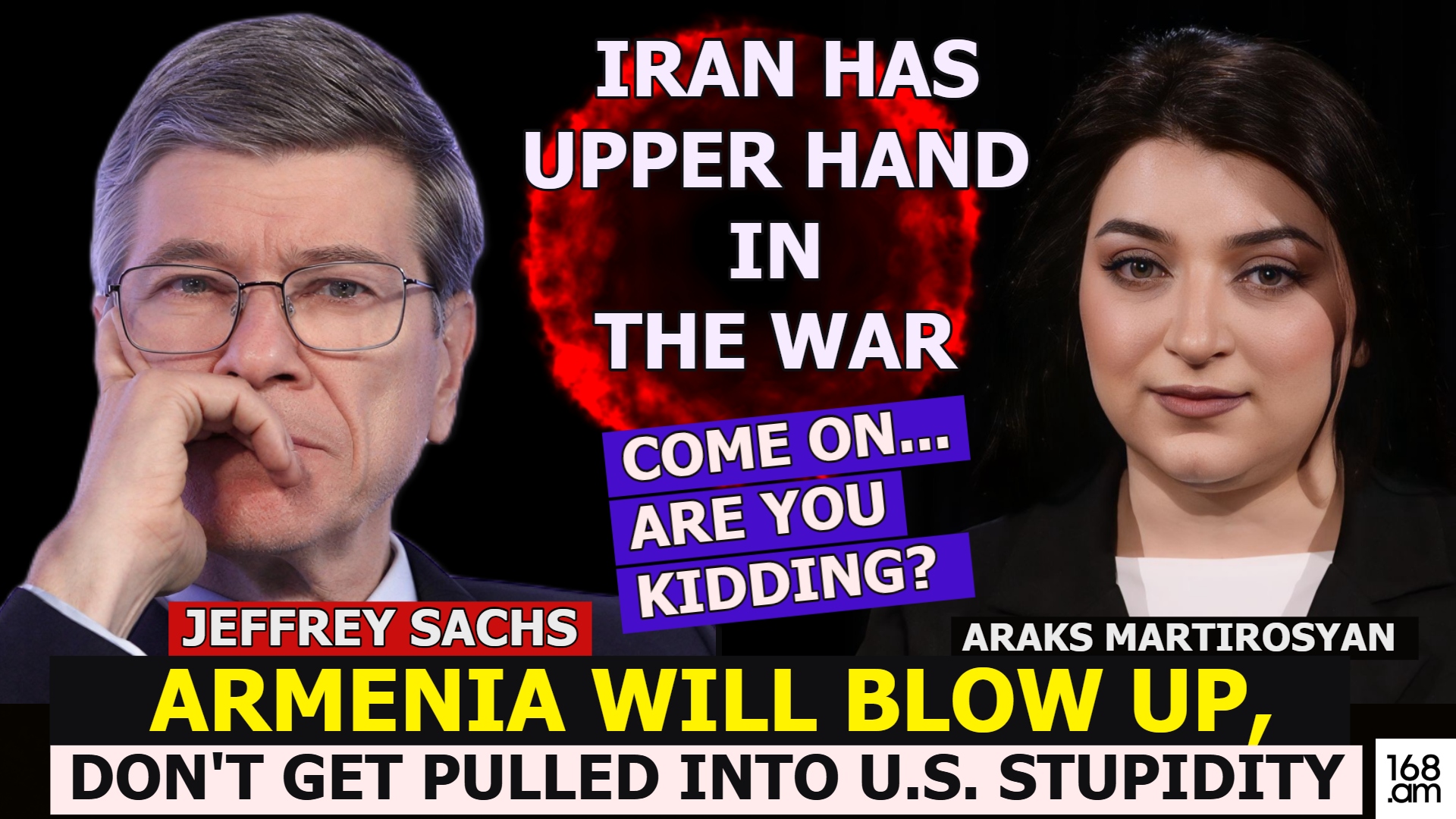
– Professor, we must address the month-long war against Iran right on Armenia’s doorstep. Given the US national security strategy released this past December, it was hard to imagine Washington getting dragged into such an exhausting war against Iran. The understanding was that Trump would pursue a policy of no more forever wars and place less emphasis on a militarized foreign policy. How did we get here and where is the US foreign policy and this war headed now?
– Excellent question, and we in America are scratching our heads as well, because the fact of the matter is Trump lied brazenly to his own people regarding his political promises. He campaigned on the basis that he would not do exactly what he is doing right now. And he is creating chaos—he and Netanyahu together.
This Israel-US war of aggression on Iran is threatening the entire world, the world economy, and global security. So, this is a war without reason. It’s been called a ‘war of choice,’ but a better term is also used: a ‘war of whim.’ In other words, Trump, Hegseth and a few people said, ‘Okay, we’ll do this.’ Perhaps Netanyahu, who is an absolutely nasty, delusional man, trapped Trump into this.
What’s clear is that there was no careful process inside the US Government, no review of options, and no consideration of the military and economic fallout of this. And so, this is a war chosen by Donald Trump. It is not in America’s interest. It is not, in this case, driven by anything other than the grandiose delusions of power that Trump and Netanyahu have. I don’t think in this case it was pushed so much by the ‘deep state,’ though the idea of US hegemony is always part of the deep state agenda.
This is a war chosen primarily by a small group—I would even say a small gang—because it is outside of American law. It is outside of international law. It is creating a global crisis. And everybody is watching this from inside the United States and internationally. So, it’s a very good question that you raise, and nobody has given a definitive answer to this. But we can see that Trump has chosen this.”
– Professor, what is the strategy of Trump’s policy in this war?
– The strategy is to try to kill as many Iranian people as possible, to destroy the Iranian government, to destroy the infrastructure, and—to put it in Trump’s terms—to drive Iran back to the Stone Age. This is rather primitive. This is rather vulgar. This is not diplomacy, strategy, international law, or even US law. This is a primitive, probably demented view of a psychopath, I would say, who is in charge in the US, together with a psychopath who is in charge in Israel. But that’s their goal. Trump explained it clearly yesterday in his speech. The goal is to drive Iran back to the Stone Age.
– Looking at the battlefield and the regional dynamics, who has the upper hand now in the conflict, in the war?
– If you look at what the markets say, they say Iran. Because as President Trump was speaking, oil prices were soaring. And that means that the markets believe that the disruption of the world energy will persist, rather than be solved quickly, and so the upper hand is with Iran according to the markets.
According to the military specialists, of course, there is a divided opinion, but many military specialists believe that Iran can basically outlast the United States because each drone is maybe $20,000, but each missile interceptor can be $2 million. And so this is not a case where defense is actually going to dominate, but where offense is. And then that raises the question: Does Iran have a lasting offensive capacity in drones and missile systems?
Again, there’s a debate. If you listen to Trump, he says we have obliterated their capacity. If you listen to most military experts, they say that Iran continues to have vast stockpiles, protected underground in bunkers, of missiles and drones and the ability to deliver them.
So I don’t think there’s a definitive answer. We’re going to find out the hard way in the next few weeks. Does the U.S. crush Iran? As vulgar and illegal as that is, it still is a question: Is it feasible from the U.S. point of view? Short of nuclear weapons, of course. And probably the answer is no. Probably Iran has major retaliatory power and will use it.
– Professor, reports from the Pentagon indicate that Washington may be gearing up for a ground invasion of Iran with a projected timeline of several weeks. Is there any strategic gain that justifies such a massive risk?
– If the war goes on for several weeks, my guess—again, I’m guessing and would really like to know more than perhaps is possible to know—but my guess is that a great deal of the energy systems in the Persian Gulf region will be destroyed by then.
So even a ground invasion will be a rather moot question from the point of view of global security and the global economy. My view is that if the war goes on for a few weeks, and Israel and the United States continue to behave the way they’re behaving and continue to accumulate troops, we will have an irreversible worldwide energy calamity, which will mean a very deep economic crisis for years to come. It would just be too late to ask the question about opening the Strait of Hormuz.
From the point of view of what a ground invasion could accomplish, of course, the United States does not have the means to conduct a ground invasion that actually conquers Iran. Iran is a vast country, a mountainous country, a difficult country with a large army. The number of troops coming from the United States is twenty or thirty thousand, perhaps. It’s not small, but it is not large enough to invade Iran. Maybe their idea is that they capture the coastline to control the Strait of Hormuz. We don’t know, because they don’t tell us.
And what they do tell us are lies, not the truth, anyway. But maybe they’re looking for a limited operation. All I can say is, again, as an economist, not a military expert: from what I hear from experts, even such a limited operation would be bloody and extraordinarily difficult.
– What will stop the war, to your mind?
– To my mind, a few grown-ups explaining to Mr. Trump reality. The grown-ups are President Xi, Prime Minister Modi, President Putin; maybe if there are grown-ups in Europe—the only one I know right now is President Sanchez of Spain—but a group of world leaders explaining to Mr. Trump: ‘Your delusions of grandeur are pushing the world to the brink, and we do not accept that, and you need to stop.
– Professor, and now about the South Caucasus. How will the war against Iran reshape the South Caucasus? We are already witnessing a clear push by the West to displace Russian and Iranian influence from our region. And in this process, a key element now is the proposed “Trump road” through Armenian territory under significant US control. Given this situation what are the primary risks to your mind for Armenia?
– Look, very simply: Anyone that signs up with Mr. Trump should have his head examined right now. If you want to sign up with Mr. Trump, go talk to Bahrain, go talk to Qatar, go talk to the Emirates, go talk to the Saudis. Ask: Is that really a very good idea? Did the U.S. protect you? Does having something called a ‘Trump highway’ or ‘Trump project’—is that really helpful for you right now? It’s a crazy idea, I’m sorry to say as bluntly as I can.
Stay away from American wars. This is not the business for the South Caucasus to get pulled into America’s and Israel’s craziness. Please stay safe. Stay outside of this craziness. America’s playing games with the rest of the world. It thinks it owns Latin America, it thinks it controls the Middle East. It wants to play games in the Caucasus.
The Caucasus is an absolutely magnificent, beautiful place of 10,000 years of culture. Don’t get pulled into the U.S. stupidity, because you’ll end up getting blown up. And something called a ‘Trump anything’ right now… watch Mr. Trump yesterday and then ask: Is that the man you’re signing up with? Because it shouldn’t be. This is very clear.
The Caucasus are where they are. You need good relationships within the Caucasus. I know it’s hard, but it’s important. And then with Russia, with Turkey, with Iran. Those are your neighbors. You let the United States in, you’re just inviting war. Please, don’t do that. The U.S. doesn’t care about war on your territory. It doesn’t care about war in Bahrain, or in Qatar, or in the Emirates. Trump said so: ‘We’re gone. You guys fix it.’ Don’t let this happen to your magnificent part of the world.
– Professor, our authorities insist that this partnership with United States and agreement around Trump Road will guarantee existence of Armenian Republic hundred years. What do you think about this?
– I think that this is very sad. Very, very sad. Armenia, first of all, needs to exist for thousands of years. Armenia has existed for thousands of years.
Armenia is not going to find security signing up with Donald Trump. Please look seriously at yesterday’s speech and just ask the question: Is that your partner? The answer- you should figure out. But I will tell you my view. The answer is no. And I’ve said it; I said it to the Gulf leaders months ago. Do not trust this. You will get blown up—your economy, your security.
The United States is a rogue nation right now. What kind of partner talks about putting Iran to the Stone Age? That’s Armenia’s safety? To have that partner, the one that said yesterday, ‘We’re going to put Iran to the Stone Age’? Let me say that correctly: That’s the partner for Armenia? Do you know how risky that is? And you think the United States is deeply dedicated to Armenia’s security? Are you kidding?
There aren’t five non-Armenian Americans that know where Armenia is in the world, including Donald Trump. He doesn’t know; he doesn’t care. If your authorities say that this is security, to sign up to some ‘Trump highway’—oh my God, come on, pay attention.
This is not security. Don’t get into American geopolitical games. Please, much too beautiful a country, much too vulnerable a country to get into America’s geopolitical games. Every day I repeat Henry Kissinger’s famous adage: ‘To be an enemy of the United States is dangerous, but to be a friend is fatal.’ Take heed. Please be careful. And anything called ‘Trump anything’ is by itself a sign you’ve got somehow the wrong calculation here.
– Professor, given the strategic partnership between Azerbaijan and Israel, and the ongoing discussions about Azerbaijan’s potential role in confrontation with Iran, is it possible that Armenia could also face external pressure to take steps against Iran?
– Let me just make a basic point, another very basic point. Israel has committed a genocide in Gaza before our eyes—mass murder of innocent people. Can that be a partner for Azerbaijan, possibly? Please, everybody stay out of trouble, because this is not safe. And Mr. Netanyahu said he cast the ten plagues on Iran.
What, does he think he’s God? This is not safe. These civilizational wars are not safe. Don’t get into them; they’re very dangerous. Stay out of wars and stay out of these absolutely unstable and dangerous situations. I’m speaking to Azerbaijan: Who needs to be blown up right now? Who needs to be part of a wider war?
Stay clear of Israel and the United States in this. Just keep your neutrality. Sell your oil to world markets; there’s a good price for it now because of the U.S. destruction. But stay away from these entanglements. I tried to explain to the Emirates: Why do you join this Abraham Accord with a country committing a genocide in Gaza? Well, they said, ‘Oh, but this is strategic for us.’ Well, how strategic is it now for the Emirates, whose whole economy is based on peace, stability, tourism, safety of bringing money to the financial markets, and so forth? What’s happened? The hotels are getting bombed, the ports are getting bombed, the oil doesn’t transit because of a regional war.
South Caucasus, please stay out of war. This is the main point.
– Professor, you insist that we must stay away from the war, from the United States, but the Prime Minister of Armenia met yesterday with Putin, and they discussed Armenia’s possible move toward the EU, despite the fact that Armenia hasn’t been invited to join the European Union. What do you think? Is Armenia expected in the EU? And what risks could this pose for Armenia?
– Countries that don’t understand their own geography, that play geopolitical games, end up paying a big price. This is Ukraine’s biggest mistake. They said, ‘Oh, we can do what we want. We can join NATO.’ And they ended up getting into a devastating, predictable war. If you look at a map, Ukraine should be neutral; then it would be safe. And that’s how it was with Mr. Yanukovych until he was ousted in a coup that was backed by the United States. My advice really for the South Caucasus is: understand the South Caucasus have a distinct, wonderful history and geography.
According to my map, in Asia, not in Europe—my understanding is that below the crest of the Great Caucasus Mountain Ridge, this is Asia—but most importantly, be careful, please. The South Caucasus should be together. They should understand everyone wants to come visit for the tourism, for the beauty, for the ancient heritage, for the ancient churches, for the great art, for the wines—you name it. They don’t want to come visit a war zone. They don’t want to come to ‘greater Israel.’ They don’t want to be part of a ‘Trump something or other.’ They want to come to the South Caucasus. And your neighbors, for thousands of years of history, by the way, are… not Israel or the United States, I have to say, but your neighbors: Russia, Turkey, Iran, and others. And the outside world should have some decent respect and distance.
And I’m sorry if the Government is a little bit behind the time and thinking somehow that the U.S. is the world hegemon, and that if you side with the U.S., you get security, and that Europe is in great shape, so that we just want to join the European Union. For what? It barely can take one step, and it’s going economically down, because the EU has done two fundamentally wrong things. One is to break its links with Russia, which is absurd, because they are perfectly complementary economies. And second, Europe has become a defense pact. Europe was once an economic pact, but now it’s all about security. So if Armenia says, ‘We want to join the European Union,’ that’s saying we want to join the European Security Alliance. That can’t make your neighbors feel very comfortable about that either.

So, I’m afraid the Government is 10 or 20 years behind. Even then, I would have disagreed with it. But look at today’s reality. Do you really want to march to war? I wouldn’t. I would stay clear of war. I would stay clear of this kind of geopolitical tension. I would try to find arrangements that are congenial within the neighborhood, because that’s who you have to live with.
– Professor, moreover, I must mention that Armenia is heading toward elections, and the current administration has invited the EU to help counter what they called hybrid threats from Russia. Given your experience with global power dynamics, do you see this as a stabilizing move, or it’s inviting further geopolitical confrontation into Armenia’s internal politics?
– Oh, I wouldn’t do that. I just wouldn’t do that. What kind of games do you want to play? If you want to have an election, keep all foreigners out. Keep all the money from the National Endowment for Democracy and the International Republican Institute and the National Democratic Institute and the EU and everyone out. Have an Armenian election, not a foreign election. Don’t put Armenia into the center of all these games.
God, what kind of security is that? If you want to have observers, ask the Secretary-General of the UN what to do to help. But the EU, U.S., or any other party, or Russia or anyone else—just stay away. Have an election inside Armenia. You don’t need the outside world to do this. Run your own election. And don’t allow money coming in from abroad, from any place. Just have a domestic election and discuss the main issue: how to remain secure in the South Caucasus without getting into the geopolitical games right now. Not Israel’s games, not Donald Trump’s games, not anyone else’s games.
– To your mind, what can we face with this kind of foreign policy?
– Well, if the invitation is ‘we want to take sides in the current geopolitical games,’ you will face, unfortunately, a very difficult future. Rather, this region should say: ‘Keep us out of the big geopolitics. We just want peace, we want economic development, we want cooperation, we want decent relations with all of our neighbors, we don’t want to go to war with anybody, and we don’t want to be used by anybody.’
We are not a pawn of the United States in its transport games between China, Russia, and Iran, so that we provide some game. We are where we are with our neighbors, with our history, and that’s where we’re going to be, and we’re going to live productively with that. Not ‘foreign policy, high stakes, we take sides.’ That’s the wrong approach.
– Professor, we have discussed that the West is working to sideline Russia and Iran in the South Caucasus, and parallel we see that Turkiye is substantially strengthening its positions in our region in the Middle East, and with the growing integration of Turkic nations, and even there are rumors of Turkic army, isn’t the rise of a neo-Ottoman empire becoming a problem for the current West?
– All attempts at imperial competition are a problem. We don’t have time for these wars—these 18th-century or 19th-century wars. So there are several powers in the world right now: Russia; Turkey in the neighborhood; Iran, definitely; China; and others.
Our main goal should not be ‘we’re on this side, we’re against this one,’ but rather: how do we make peace and stability without stepping on each other’s toes, crossing each other’s red lines, or playing games that threaten each other? Putting in whatever kind of infrastructure that says, ‘Oh, it’s good for you, but it hurts them, and it’s good for you because it hurts them’—if that’s the attitude, it’s a loser.
The infrastructure should be win-win. It should not divide. It should not try to take sides. Taking sides will lose. There are a number of powers, and they should participate peacefully together.
– Professor, we have also observed a troubling pattern in post-revolutionary states like Georgia, Ukraine and Armenia. Beyond the political shifts, there is often a systematic campaign against traditional institutions like the Church. In Armenia this past year has been dramatic. The government is in an open confrontation with the Armenian Apostolic Church involving criminal cases, arrests and demands for the Catholicos to step down. Why do these revolutionary movements often target the church? Is this an attempt to dismantle national identity to make these nations more malleable in the global geopolitical game?
– Truthfully, I have not followed events in Armenia in this regard, but I have followed events in Ukraine, for example, where the Church has been heavily politicized as part of the geopolitical and military struggle. And this is tragic. And by the way, it leads to the desecration and sometimes even the destruction of cathedrals and basilicas that date back hundreds or even thousands of years, which is our most precious heritage.
I don’t know the specifics, but people with power try to instrumentalize anything, including religion. I don’t like governments going after religious leaders, figures, and institutions, because they are instrumentalizing religion.
I don’t want the religious trying to determine the politics either. So it’s a matter of mutual respect and mutual spheres of activity. I don’t know the circumstances in Armenia, but I do see these abuses taking place, and they’re very harmful—they’re very dangerous. People want their culture and their religion for themselves, and they don’t want this to be instrumentalized in politics.
– Professor, դo you believe the current breakdown of international order is a symptom of a deeper value crisis, where principled policy has been replaced by pure political expediency?
– Of course, what we have is… a failure of the old leadership—that is the U.S. and Europe—to accept a multipolar world. The U.S. is trying to maintain its global hegemony. So the U.S. is saying: ‘We’ll beat the Iranians to a Stone Age, we’ll surround Russia, we’ll… arm Taiwan, we’ll invade Venezuela,’ all to try to prove U.S. power. The U.S. is an empire; it’s a particular kind of empire.
It operates through its military bases all over the world. The goal of the empire is to choose who governs where. Trump wants to choose who governs in Iran. Most places don’t want the United States to be the one that determines their politics. National leaders should not succumb to the temptation of saying, ‘Oh, we love you, Mr. Trump, please help us, please protect us,’ because this is devastating for countries that behave that way.
And so we are in a very difficult situation because we have entered a multipolar world, while Europe and the United States are trying to defend their old prerogatives. And they thought they had won. The Soviet Union ended; now the United States thought it runs the world. And that was its delusion after 1991. Unfortunately, that delusion has persisted, and if anyone watches Donald Trump in his speech, you can see that not only do we have the national delusion, we have a delusional president.
– Professor, what will follow the current stage of global chaos if politics without a moral foundation ultimately leads to its own destruction? What will eventually fill this vacuum of values?
– We don’t have a vacuum; we have a challenge. We have the UN Charter. We have the Universal Declaration of Human Rights. We have the Sustainable Development Goals. We have a system of international law. The point is, it’s all under assault. It’s all under threat. The United States is abandoning it.
So, I am not ready to see it all collapse just because the U.S. says so. I am interested in the rest of the world saying: ‘No, we’re not going to let the U.S. destroy all of this. We are going to continue with international law, with the UN Charter, with the Human Rights Council, with many other things.’ And if one country—the U.S.—doesn’t want to participate, it won’t. But for the rest of us, we’re going to go forward. That’s how I would like to see things
– Professor, and as a final thought, we are living through a period of violent global realignment and a redrawing of spheres of influence. And in this new world disorder, what is your fundamental advice to small nations like Armenia? You have already advised very important things. But as a final thought, what is your advice to nations like Armenia, taking into consideration geography and all the challenges?
– My strong advice to all countries is: cooperate with your neighbors and keep peace. And do not be sucked into great power games. For Armenia specifically, that means that there needs to be cooperation of Armenia, Georgia, and Azerbaijan as the South Caucasus countries. They need to get along with Russia, with Türkiye, with Iran as three regional powers. The South Caucasus should have normal relations with Europe, but also with China, with India, with other major powers as well.
So the goal should be peace and development with cooperation and avoiding games by the United States or other powers that can drag Armenia into crises that are not of Armenia’s interest or making. And the United States is playing games all over the world—very dangerous games: attacking Iran, trying to control the Gulf region, trying to control South America, trying to corner China. And for a government, the first—like the antennae on the head—should say, ‘We need to be careful not to get into such games.’ This is the main point.
Armenia’s real task is: help your children get a good education, have good lives, protect the beautiful culture of one of the great civilizations of the world that goes back thousands of years. And not to fall into some American delusion about Israel’s fighting with Iran or some craziness like this, or that Armenia is going to be on America’s side against China and Russia. Come on! This is absolutely not the right way to go.
Be careful and be in good contact with neighbors, and everybody protect against the outside influences that are angling for advantages but not interested in Armenia’s fate.
By ARAKS MARTIROSYAN